Clermont
1807 · Paddle Steamer · Work 162 of 1,871
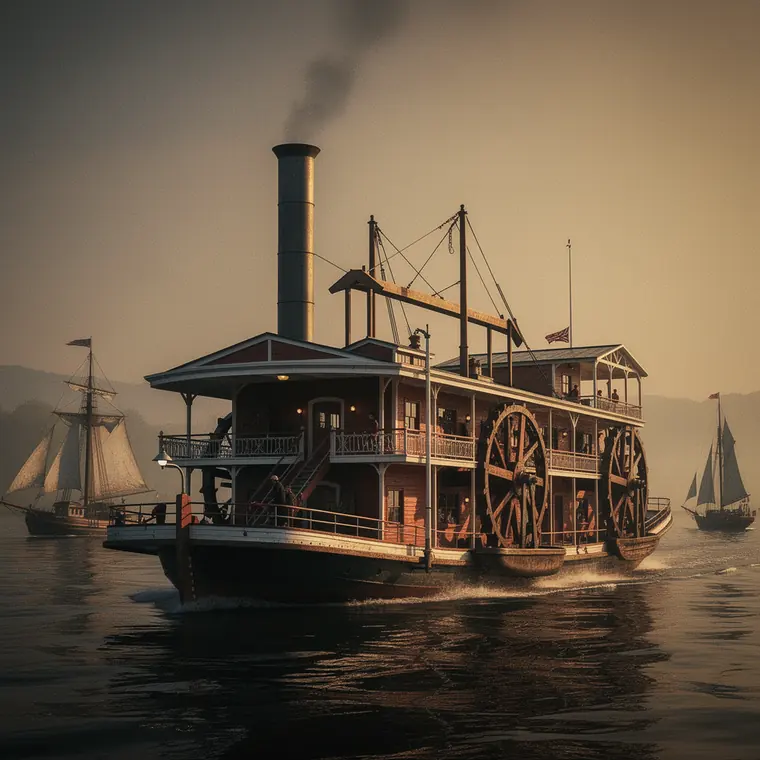
Fulton's steamboat Clermont on the Hudson river, tall thin funnel amidships between two uncovered paddle wheels, walking beam rocking above the deck, sailing sloops giving way alongside.
- What it was used for
- In Fulton's lifetime the vessel was called the North River Steam Boat; "Clermont" is a later name. Robert Fulton and Robert R. Livingston ran it as a passenger packet between New York and Albany, calling at Livingston's estate. Fulton wrote to Joel Barlow on 22 August 1807, in a letter printed in the American Citizen: "The distance from New-York to Albany is 150 miles; I ran it up in 32 hours and down in 30 hours." The advertisement of September 1807 quoted seven dollars and 36 hours to Albany, three dollars and 14 hours to Newburgh. The State of New York's monopoly hung on a condition: a boat of at least twenty tons averaging not less than four miles an hour.
- What was new
- It was not the first steamboat. John Fitch ran a passenger service on the Delaware in 1790; of it the Pennsylvania Historical and Museum Commission records: "Few people used the service, however, so the company soon failed." William Symington was towing on the Forth and Clyde Canal in 1803. What was new about Fulton's line was that it lasted: an advertised, tariffed service over 150 miles upstream. The engine itself came from Boulton & Watt in England. The price lay in the business model: the New York State monopoly that had made the venture financeable was struck down by the Supreme Court on 2 March 1824 in Gibbons v. Ogden — and the New York State Library notes that nothing then prevented a new monopoly from being rigged.
Further reading
- New York State Library: Battle of the Newspapers (Fultons Brief 1807, Anzeige September 1807)
- New York State Library: Competition (Gibbons v. Ogden, neues Monopol)
- Linda Hall Library, Scientist of the Day: Robert Fulton (Name, Boulton-&-Watt-Maschine)
- U.S. National Archives, Milestone Documents: Gibbons v. Ogden
- ExplorePAHistory (Pennsylvania Historical & Museum Commission): John Fitch's Steamboat
- New York State Library: Battle in the Legislature (Gesetze 1798, 1803, 1807: Boot von mindestens 20 Tonnen, mindestens vier Meilen in der Stunde)