Comet
1812 · Clyde Paddle Steamer · Work 163 of 1,871
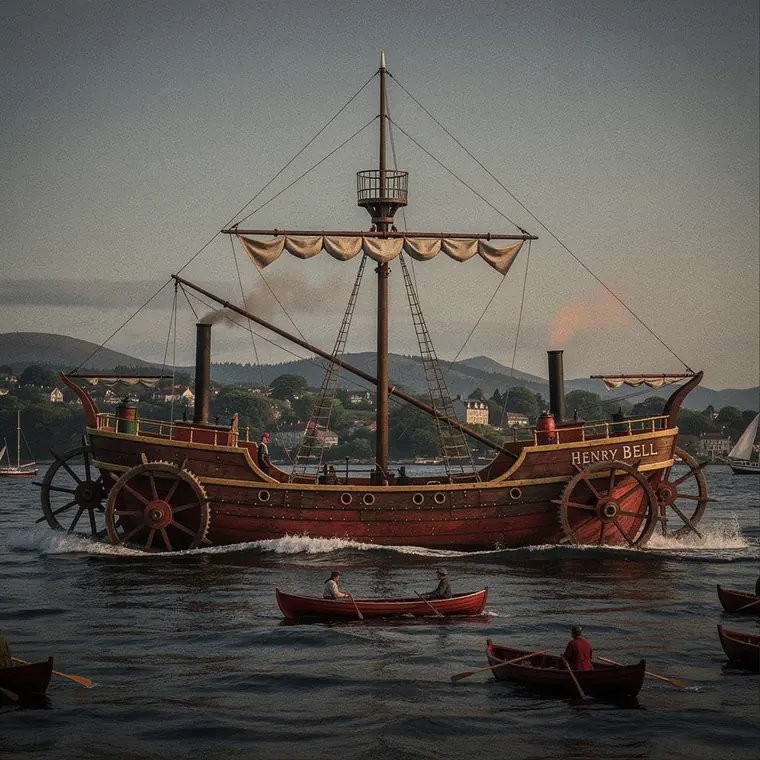
Henry Bell's Comet steaming on the Clyde off Helensburgh, tall funnel doubling as a mast carrying a square sail, two small paddle wheels on each side, rowing boats nearby.
- What it was used for
- Henry Bell put the Comet into service on the Clyde in August 1812 (HES: from 15 August; Grace's Guide: first fare-paying run on 8 August), between Glasgow, Greenock and Helensburgh. The advertisement offered her "FOR PASSENGERS ONLY"; the best cabin cost four shillings, the second three. The real purpose lay ashore: Bell and his wife ran the saltwater baths and the Baths Hotel at Helensburgh, and he built a small pier beside it for the guests. On the trial run of 6 August 1812 she made, per Grace's Guide, the 24 miles from the Broomielaw to Greenock at five miles an hour against a headwind; the Helensburgh–Glasgow journey fell from about twelve hours to three and a half. The steamer of the same name lost in 1825 (62 dead per HES, some 73 per Scottish Shipwrecks) was a successor vessel, not this ship.
- What was new
- What was new was not steam propulsion — Fulton was five years earlier, Symington nine — but that here a steamship in Europe kept a timetable and paid its way: independent of wind and tide, where travellers had previously waited for sailing boats. Historic Environment Scotland rates the Comet as Europe's first commercial steamship. How powerful the engine was is disputed: figures range between three and four nominal horsepower, and the Science Museum, which owns the original engine, gives none at all in its object description. From September 1819 Bell put her on the open west coast run to Fort William, for which, in the Science Museum's judgement, she was "not powerful enough"; on 19 December 1820 (so HES; Grace's Guide: 15 December) she broke up at Craignish Point. The engine was salvaged and afterwards drove a factory.
Further reading
- Historic Environment Scotland: Henry Bell's Comet Designated (Wrack, Datum, Einordnung)
- Science Museum Group Collection: The original engine of Henry Bell's paddle steamer Comet
- Historic Environment Scotland Blog: Henry Bell, Helensburgh and The Comet
- Grace's Guide: PS Comet (Anzeigentext 1812, Fahrpreise, Leistungsangaben)
- Scottish Shipwrecks: Comet II (Untergang 1825)
- Helensburgh Pier: Henry Bell & PS Comet (Reisezeit Helensburgh-Glasgow von etwa 12 auf 3,5 Stunden; kleiner Pier am Baths Hotel; Wrack 19.12.1820; Comet II 62 Tote)