Savannah
1819 · Sail and Paddle Steamer · Work 164 of 1,871
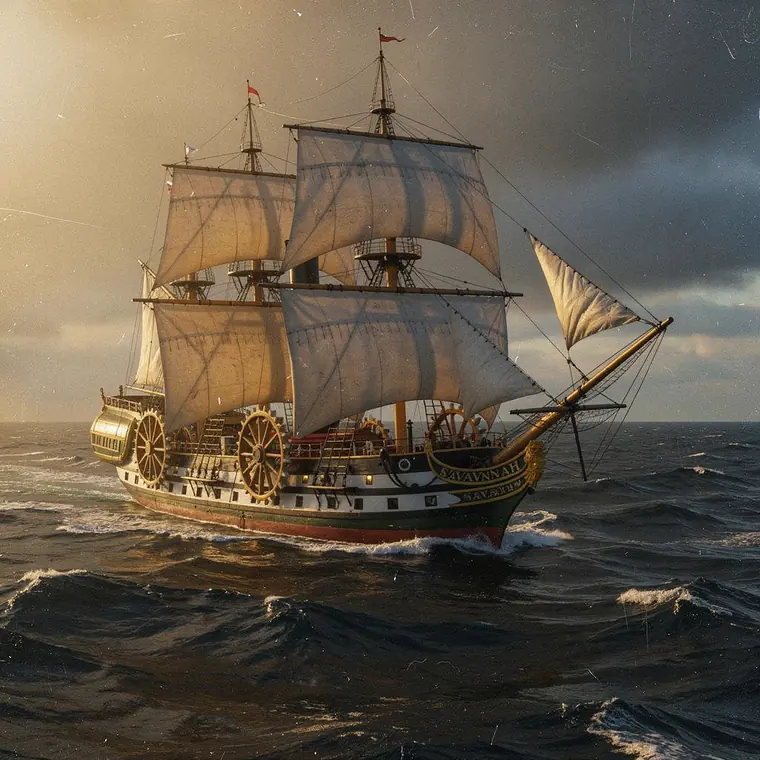
The ship-rigged Savannah under full canvas in the open Atlantic, bent elbow smokestack amidships, folding paddle wheels unshipped and stowed in fan sections along the bulwarks, three masts.
- What it was used for
- The Savannah Steam Ship Company around William Scarbrough bought no new vessel but a three-masted sailing packet of 320 tons then on the stocks, and had a 75-horsepower engine and collapsible paddle wheels fitted for a total of 66,000 dollars. Captain Moses Rogers was to demonstrate in Europe that steam would serve at sea — the ship was a travelling sales display. She left Savannah on 22 May 1819 and reached Liverpool, according to the U.S. Maritime Administration, in 29 days and four hours. On board were 25 cords of wood and 1,500 bushels of coal, but, the Smithsonian records, not a single paying passenger and no cargo.
- What was new
- What was new were the collapsible wheels, which could be lifted out of the water for sailing — fixed wheels would have dragged or been damaged in a seaway, and only this made a hybrid Atlantic passage thinkable. A steam crossing it was not: the engine ran only about 80 hours according to the Smithsonian's logbook record, a second Smithsonian record gives about 100 hours, or 16 per cent of the time, and MARAD writes that historians have estimated the ship was under sail 80 per cent of the time. The proof stayed unsaleable: Rogers turned down an offer of 100,000 dollars payable in hemp and iron, the eventual buyer took the engine out again, and on 5 November 1821 the ship ran aground off Fire Island as an ordinary sailing vessel.
Further reading
- U.S. Maritime Administration (MARAD): National Maritime Day History
- Smithsonian NMAH: Logbook for First Transatlantic Steamship Savannah, 1819
- Smithsonian NMAH: Rigged Model, Auxiliary Steamship Savannah
- New London Maritime Society, McGuire Maritime Library: The Savannah Steam Ship Company
- International Propeller Club: National Maritime Day (Liverpool in 29 Tagen und vier Stunden; Historiker: 80 Prozent unter Segeln; gleicher Wortlaut wie MARAD)
- EBSCO Research Starters: Savannah Crosses the Atlantic (Fickett & Crockett, 320 Tonnen, klappbare Räder, 22.5.1819, 80 bis 100 Stunden unter Dampf, keine Passagiere und keine Fracht, Maschine ausgebaut, Fire Island 1821)