Aaron Manby
1822 · Iron River Steamer · Work 165 of 1,871
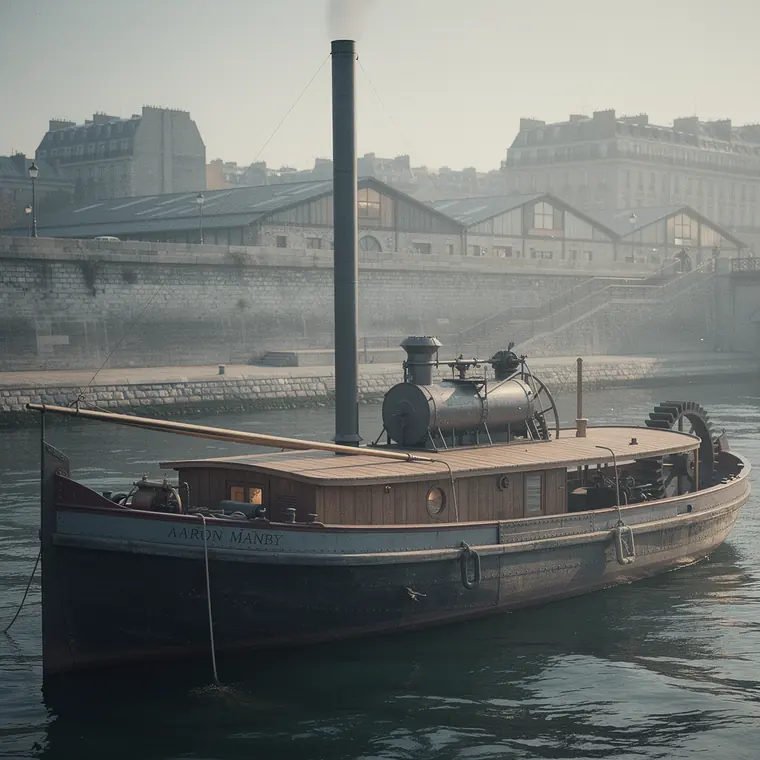
The iron steamer Aaron Manby moored on the Seine at Paris, a long low flat-bottomed hull of riveted iron plate on angle-iron ribs drawing almost nothing, a single flat wooden deck with a bowsprit, one very tall thin funnel rising from the middle of the deck, oscillating engine housing amidships, a narrow paddle wheel on each side, engine housing, paddle boxes and rails, stone quays with low stone and timber warehouses behind.
- What it was used for
- The hull of quarter-inch iron plate was made in pieces at the Horseley Ironworks in Tipton, in the middle of the Black Country, and riveted together on the Thames; the trial run took place on 9 May 1822. Under Charles Napier the ship then crossed the Channel to Le Havre and went up the Seine to Paris, arriving, by the obituary's account, on 12 June 1822 (the DNB says the 11th). The engineer on board was the barely eighteen-year-old Charles Manby, who had installed the engine himself; so his 1885 obituary at the Institution of Civil Engineers records. Laden, the same source says, she drew three feet six inches — shallow enough for the river and strong enough for the sea. Years of Seine traffic followed.
- What was new
- What was new was less the material than the method: a seagoing ship was made as a kit some 200 kilometres inland from the Thames and riveted together at the coast. That this was deliberate Grace's Guide confirms: the Aaron Manby was the first of a number of Horseley steamboats built on the knock-down principle; Manby ran an engineering works at Charenton near Paris. On the engine the sources disagree: the 1885 obituary names a single engine of 80 horsepower, the Cumberland Pacquet of 20 May 1822 gives 30; the only point they share is Oldham's feathering paddle wheels. Iron building did not prevail for decades afterwards: Lloyd's Register carried the notation "built of iron" only from 1837 and rules for iron ships only from 1863, and Liverpool underwriters kept a register of their own from 1862 to 1885.
Further reading
- Institution of Civil Engineers, Nachruf Charles Manby (1885), Volltext
- Dictionary of National Biography 1885–1900: Manby, Aaron (Montage am Surrey Canal Dock)
- Irish Waterways History: The Aaron Manby and the Shannon (zitiert Cumberland Pacquet, 20.05.1822)
- Lloyd's Register Foundation Heritage Centre: 19th century Register Books
- Aberdeen Art Gallery and Museums: Aaron Manby, First Iron Steamship (55 Stunden London–Boulogne)
- Grace's Guide: PS Aaron Manby (Viertelzoll-Eisenblech auf Winkeleisenspanten; in Teilen nach Rotherhithe; 10.6.1822 unter Napier nach Le Havre, Seine hinauf nach Paris; Oldhams Federräder)
- Grace's Guide: Horseley Ironworks (Aaron Manby als erstes einer Reihe von Schiffen nach dem Bausatzprinzip)