Royal William
1833 · Atlantic Paddle Steamer · Work 166 of 1,871
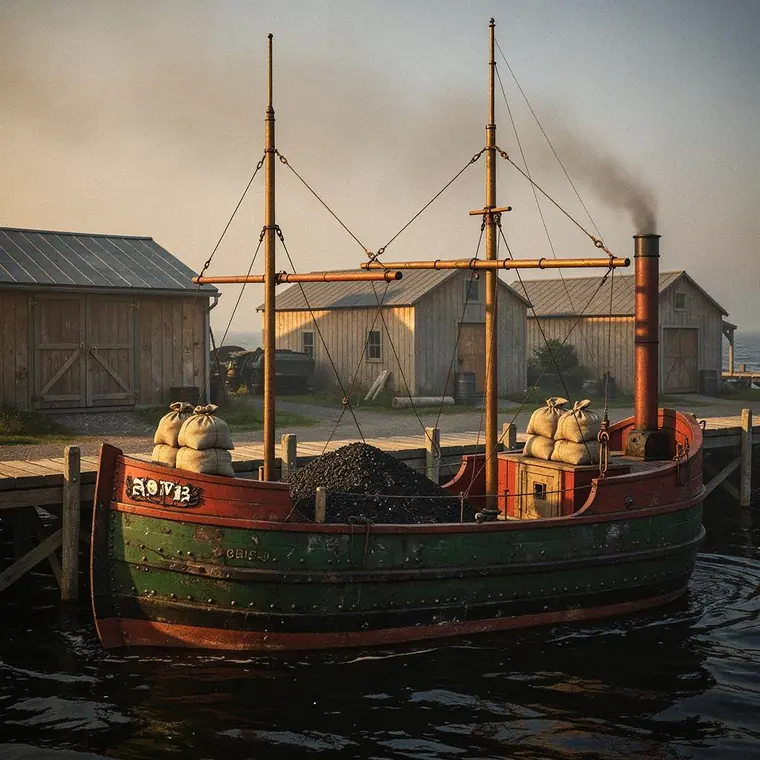
The paddle steamer Royal William taking coal aboard at Pictou in Nova Scotia, sacks swung over the bulwarks, three masts and one funnel, paddle boxes bearing carved arms, wharf sheds behind.
- What it was used for
- Built at Quebec in 1831, with 200-horsepower engines from Montreal, the ship ran for the Quebec and Halifax Steam Navigation Company between Quebec and Halifax. Among its more than 200 shareholders was Samuel Cunard. In 1832 a cholera epidemic wrecked the service: the ship lay in quarantine at Miramichi and Halifax and idle for much of the season. In the spring of 1833 it went to the mortgagees for £5,000, having cost £16,000 to build. The famous Atlantic voyage went to London, where, per the Naval Marine Archive, the buyers hoped to recoup part of her lost value: out of Pictou in August 1833 with seven passengers, 254 chaldrons of coal and a crew of 36, reaching Gravesend after 25 days.
- What was new
- What the ship could do: carry enough coal for an eastbound crossing and burn most of it, as a commercial vessel rather than an experiment. Continuous steaming it was not — the boilers ran on seawater and had to be scraped of salt about every fourth day, for which sail was set, and after a gale off Newfoundland the ship ran for ten days on her port engine alone. Who was first depends on the yardstick: the New London Maritime Society assigns to the Savannah the first crossing in which steam power was used, to the Sirius the first under continuous steam, and to the Royal William a crossing made almost entirely under steam. The price: Cunard and the other shareholders lost their money, the ship was sold to Spain in 1834 and ended as the warship Isabel Segunda.
Further reading
- Dictionary of Canadian Biography: CUNARD, Sir SAMUEL (Anteilseigner, Cholera, £16.000/£5.000)
- James Croil: Steam Navigation and Its Relation to the Commerce of Canada and the United States (1898)
- Naval Marine Archive: The record-making Royal William 1833
- New London Maritime Society: The Great Debate — Which Steamship was First to Cross the Atlantic?
- Curt Wohleber: The Annihilation of Time and Space, Invention & Technology 7 (1991) 1