Sirius
1838 · Mail Paddle Steamer · Work 167 of 1,871
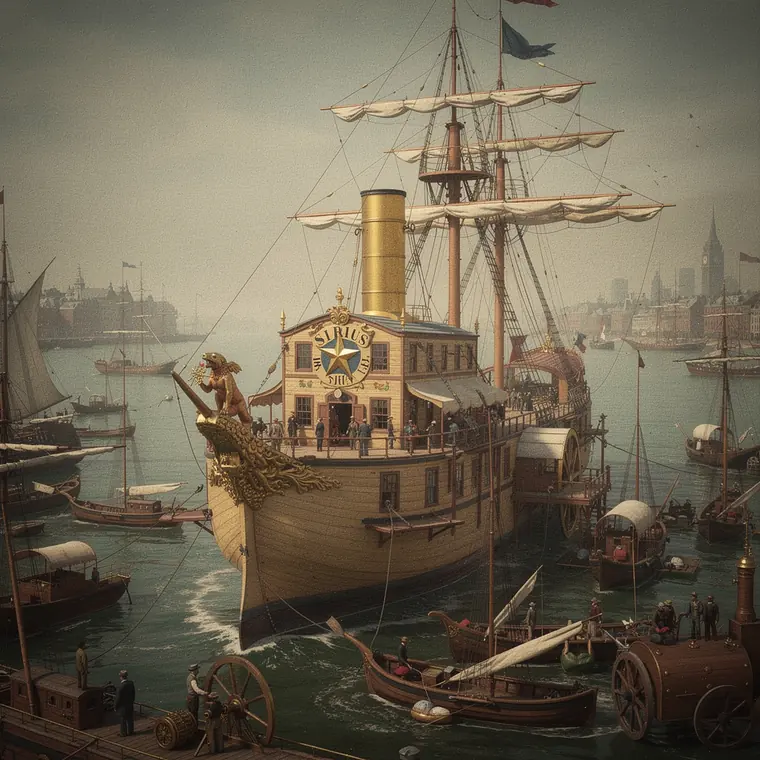
The paddle steamer Sirius entering New York harbour after her Atlantic crossing, a wooden-hulled ship with a large paddle wheel in a box on each side, dog figurehead clutching a star at the bow, two masts, single funnel abaft the paddle boxes, harbour craft crowding around her: sailing sloops, rowing boats and small sailing ships, the shoreline behind low wharves, warehouses and church spires of at most a few storeys.
- What it was used for
- The Sirius was built in 1837 by Robert Menzies & Son of Leith for the St George Steam Packet Company's London–Cork run, 703 gross register tons. For the Atlantic voyage she was merely chartered: Junius Smith's own new ship was not finished, because the engine builder ran into financial trouble and then went bankrupt. Part of her passenger accommodation was stripped out and filled with coal bunkers. She left London on 28 March 1838 and Cork on 4 April, with 40 passengers, 450 tons of coal and 20 tons of water; she reached New York after 18 days, four hours and 22 minutes. Afterwards she returned to the Irish Sea trade; on 16 January 1847 she was lost at Ballycotton, and 20 people died.
- What was new
- The feat was one of logistics, not of design: a coastal packet kept her fires going on a westbound run against the prevailing wind, where the Royal William five years earlier had run east with the wind and had to set sail regularly. It was paid for with cabins turned into bunkers. The Great Western left Bristol four days later, arrived a few hours after the Sirius and still had 200 tons of coal on board — the faster steamer lost the date, not the argument. Whether the crew burned furniture at the end is open: the Lloyd's Register Foundation writes that it is alleged the crew used newspaper, furniture and a spare mast as a fuel supplement; other accounts name spars and resin, and the arrival manifest lists 58 barrels of resin as cargo.
Further reading
- Lloyd's Register Foundation Heritage Centre: Two ships called Sirius
- Charles Miller Ltd: The New York arrival manifest for the S.S. Sirius (Los 195, 02.05.2017)
- Curt Wohleber: The Annihilation of Time and Space, Invention & Technology 7 (1991) 1
- The Irish Times: An Irishman's Diary on the SS Sirius
- Nautical Nostalgia (Sea Breezes): The Great Western (Abfahrt Bristol 8. April 1838, Ankunft 23. April mit 200 Tonnen Restkohle)
- Graces Guide: Sirius (Teil der Passagierunterkunft für zusätzliche Kohlebunker ausgebaut; Wrack 16. Januar 1847)