Archimedes
1839 · Screw Steamer · Work 168 of 1,871
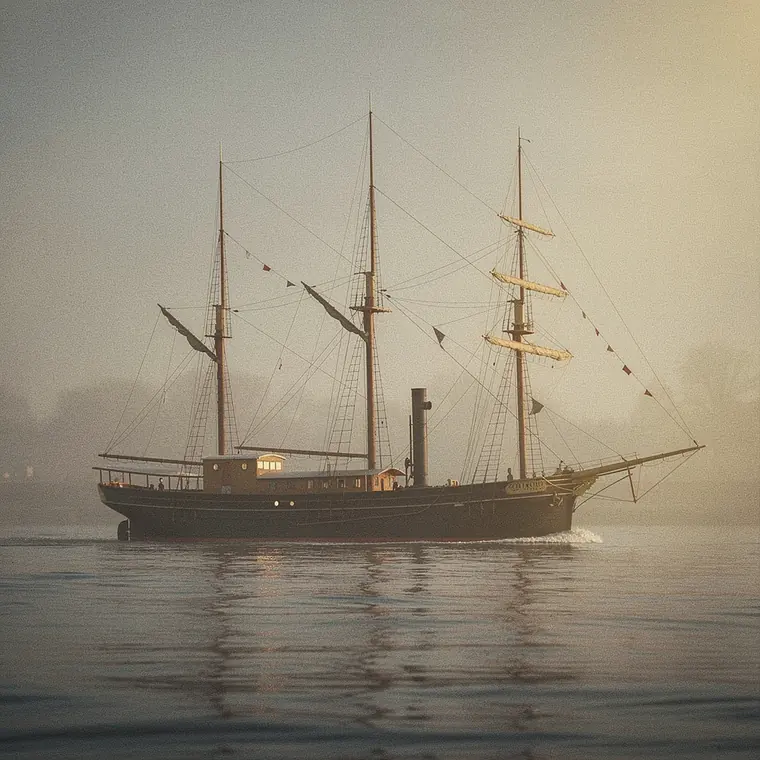
The screw steamer Archimedes running trials on the Thames: a slender schooner-hulled steamer of about 125 feet, three raking masts with fore and aft rig, a tall thin raking funnel abaft the mainmast, sitting deep and level in the water with the waterline high on the hull, the stern and rudder cutting the water and a churned white wake streaming out behind her from beneath the surface, all her machinery and her screw out of sight under the water, the bow a plain sharp stem, the hull long and low.
- What it was used for
- The Ship Propeller Company built the ship because the Admiralty wanted to see a vessel of not less than 200 tons before deciding: a wooden hull of 237 tons, a screw of one turn in the deadwood, a pair of engines of 80 horsepower. It was the test ship the Admiralty had asked for; its purpose was demonstration. In May 1839 it ran from Gravesend to Portsmouth; in 1840 it was placed at Captain Edward Chappell's disposal for trials against the Admiralty packet Widgeon at Dover and for a circuit of Britain's principal ports — a selling tour before shipowners and shipbuilders, since what was on offer were patent licences. Francis Pettit Smith ended as curator of the Patent Office Museum, on a civil list pension of £200 a year.
- What was new
- The point at issue was steering: the surveyor of the navy opposed the method, Samuel Smiles records, "because of the impossibility of making a vessel steer which was impelled from the stern". The ship was built on the expectation of four or five knots; by the same source she made nine and a half. Who had the screw first is unresolved: Ressel tried one at Trieste in 1829, Sauvage took a patent in 1832, Smith took British patent no. 7104 on 31 May 1836, Ericsson no. 7149 on 13 July 1836 — and the USNI Proceedings write that Ericsson preceded Smith in the demonstration before the Admiralty by three or four months. The consequence was large, the return small: Brunel inspected the ship and switched the Great Britain, then building, to the screw; the company never paid a dividend and lost about £50,000 by Smiles's account, and when the patent expired in 1856, 327 ships of the Royal Navy were running with screws.
Further reading
- Samuel Smiles: Men of Invention and Industry (1884), Kap. II, Francis Pettit Smith
- Dictionary of National Biography 1885–1900: Smith, Francis Pettit
- Naval Marine Archive: The early inventors of propellers and their patents
- USNI Proceedings (April 1931): The Early History of the Screw Propeller
- Royal Museums Greenwich: The Archimedes, Gravesend–Portsmouth, 14. Mai 1839
- Naval Marine Archive: Early propeller history (nach H. F. D. Davis, USNI Proceedings April 1931: Ericsson der Admiralität 'three or four months' vor Smith vorgeführt)
- Edward Chappell: Reports relative to Smith's Patent Screw Propeller, as used on board the Archimedes ... in various trials with Her Majesty's Steam Packet Widgeon, at Dover, and subsequently in a circumnavigation of Great Britain (London: Ridgway, 1840)
- Graces Guide: Josef Ressel (Patent 1827; Versuch mit der Civetta im Hafen von Triest 1829)
- Larousse: Frédéric Sauvage (1832 Patent für die Anwendung der Schraube auf den Schiffsantrieb)