New Orleans
1811 · Sidewheel Steamer · Work 169 of 1,871
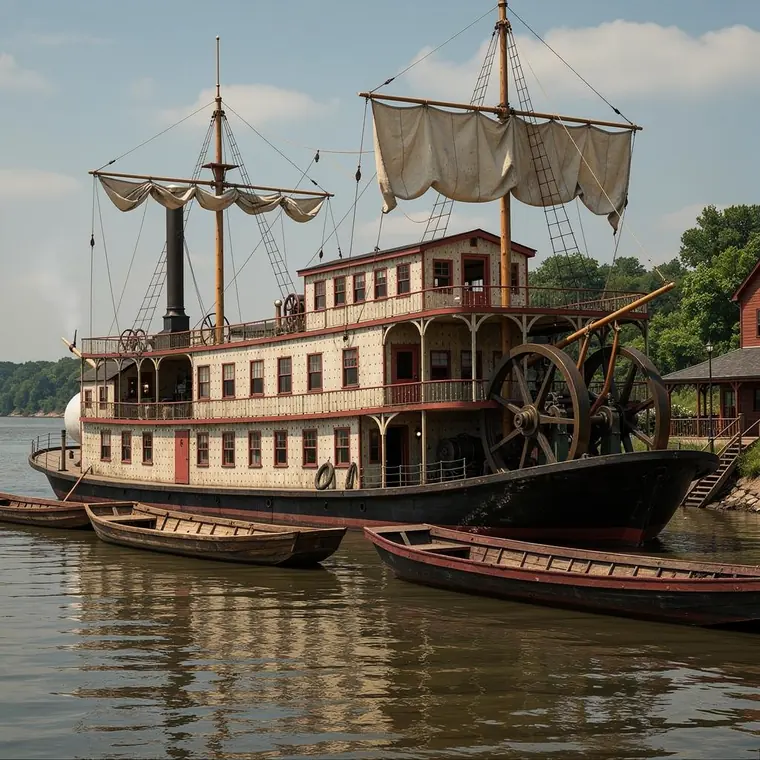
The steamboat New Orleans lying at the Natchez landing on the Mississippi, low rectangular deckhouse, one slim funnel forward, two side paddle wheels, masts with furled sails, flatboats along the bank.
- What it was used for
- The capital came from Robert Fulton and Robert R. Livingston; Nicholas J. Roosevelt directed the building and the delivery voyage at Pittsburgh, whose purpose was to take possession of the steamboat monopoly on the western waters. The boat left on 20 October 1811 and reached New Orleans in early January 1812 — the Louisiana Gazette of 13 January, reprinted in the Pittsburgh Gazette of 14 February, reported arrival on the previous Friday evening, 10 January; Kendall and the Corps of Engineers give the 12th. The route lay in the New Madrid earthquake zone, where between 16 December 1811 and 7 February 1812 severe shocks shifted the channels. Afterwards the boat ran as a packet between Natchez and New Orleans. John H. B. Latrobe, brother of Lydia Roosevelt who made the voyage, put the building cost in 1871 at about 38,000 dollars, the U.S. Army Corps of Engineers at 40,000.
- What was new
- What the boat could do was come back: flatboats drifted downstream and were sold or burned at the far end, this one ran against the current. Not by much — the Pittsburgh Gazette reported on 6 March 1812, after the Louisiana Gazette and on a passenger's authority, upwards of three miles an hour and 75 miles in 24 hours, and called the first Natchez run one made "more for experiment than emolument". For the Ohio that was not enough: the boat stayed in service between New Orleans and Natchez and struck a stump in 1814. By John Kendall's reckoning it made thirteen trips to Natchez at an average gross revenue of 2,400 dollars — together less than the boat had cost to build. The proof that steam could climb the river came in 1817 from a competitor: Henry Shreve's Washington, built in 1816.
Further reading
- Pittsburgh Gazette, 6. März 1812 (Transkript, Hanover College Historical Texts Project)
- U.S. Army Corps of Engineers, New Orleans District: Mississippi River Navigation (PDF)
- John H. B. Latrobe: The First Steamboat Voyage on the Western Waters (1871), Illinois State Museum
- John Kendall: History of New Orleans (1922), Kap. 12 (dreizehn Fahrten, 2.400 Dollar)
- Heinz History Center: The Incredible Journey of the Steamboat New Orleans
- Pittsburgh Gazette, 14. Februar 1812, nach der Louisiana Gazette vom 13. Januar: Ankunft 'on Friday evening last' (Transkript, Hanover College Historical Texts Project)