Natchez
1869 · Pilot House · Work 171 of 1,871
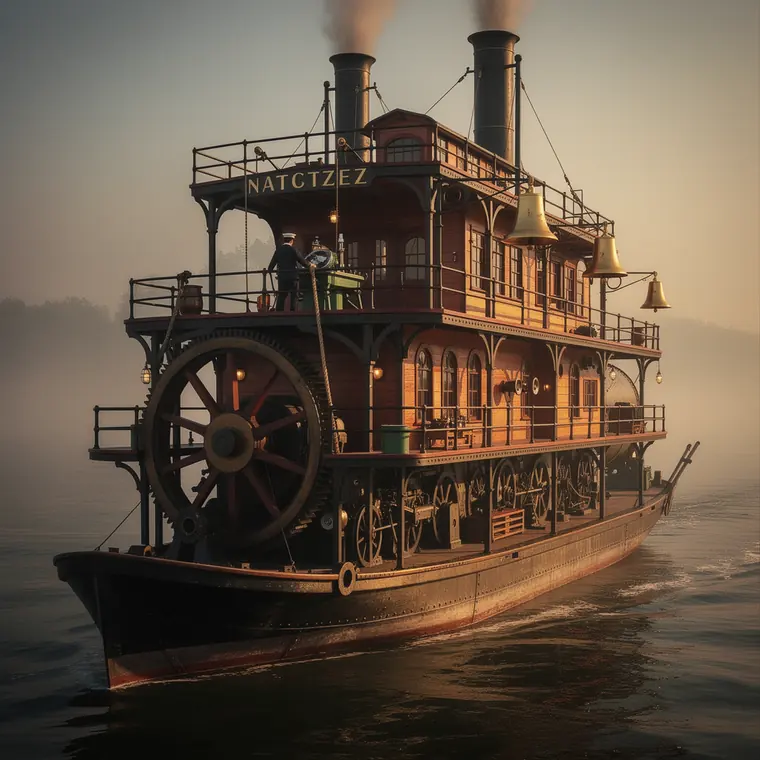
The pilothouse of the Mississippi packet Natchez perched above the texas deck, huge spoked wheel with the pilot at the helm, speaking tubes and bell ropes, chimneys rising forward.
- What it was used for
- The sixth Natchez, owned by Captain Thomas P. Leathers, was a sidewheel packet in the New Orleans–Vicksburg trade: cotton downriver, plus passengers and general freight. Maiden voyage 6 December 1869; cost about $200,000. The city of Natchez credits the route with 401 trips without accident. In 1874 she loaded 5,511 bales of cotton — more than the far more famous J.M. White ever carried. In 1879, bound for Cincinnati to be dismantled, she stranded at Rising Sun, Indiana; per the University of Wisconsin catalogue card she lay at the Cincinnati Marine Ways until 1881, was then towed to Jeffersonville, and her hull later served as a wharfboat below Vicksburg.
- What was new
- No technical first is documented for the Natchez. She was a very large, very fast example of an established type; the claim that she was designed to carry unprecedented volumes of freight at a competitive speed appears in an account that offers no comparative figure at all. Her fame rests on the race against the Robert E. Lee in early July 1870 — which she lost. Leathers left his boat almost as she was, carried passengers as on a scheduled run and insisted ever after that without his stops the Natchez would have won. Sources differ on the margin: the city of Natchez gives a little over six hours, American Heritage's arrival times imply nearly seven; the 3 hours 44 minutes also given there is the Lee's improvement on the Natchez's June 1870 record for the route, not the race margin.
Further reading
- Captain Thomas P. Leathers – City of Natchez, Mississippi
- Natchez (Packet, 1869-1879) – University of Wisconsin-Madison Digital Library
- Going For The Horns – American Heritage, Feb/Mar 1980
- The Many Lives of the Steamboats Natchez – FrenchQuarter.com
- The Waterways Journal: Steamboat Race Sesquicentennial (sechste Natchez unter Leathers, 1869 Cincinnati Marine Ways; Lee 3 Tage 18 Stunden 14 Minuten)
- 64 Parishes: Great American Steamboat Race (Cannon strippte die Lee, keine Fracht, Passagierliste beschränkt; Leathers fuhr mit normaler Passagierlast; Nebelstopp)
- Benton Rain Patterson: The Great American Steamboat Race, Kap. 'Celebration in St. Louis' (Lee 11:24:30 Uhr; Natchez gegen 18 Uhr, 'some six and a half hours behind'; Lee unterbot den Natchez-Rekord vom 22.6.1870 um 3 h 44 min; rund 70 Kabinenpassagiere)