Delta Queen
1926 · Steel Hulled Sternwheeler · Work 174 of 1,871
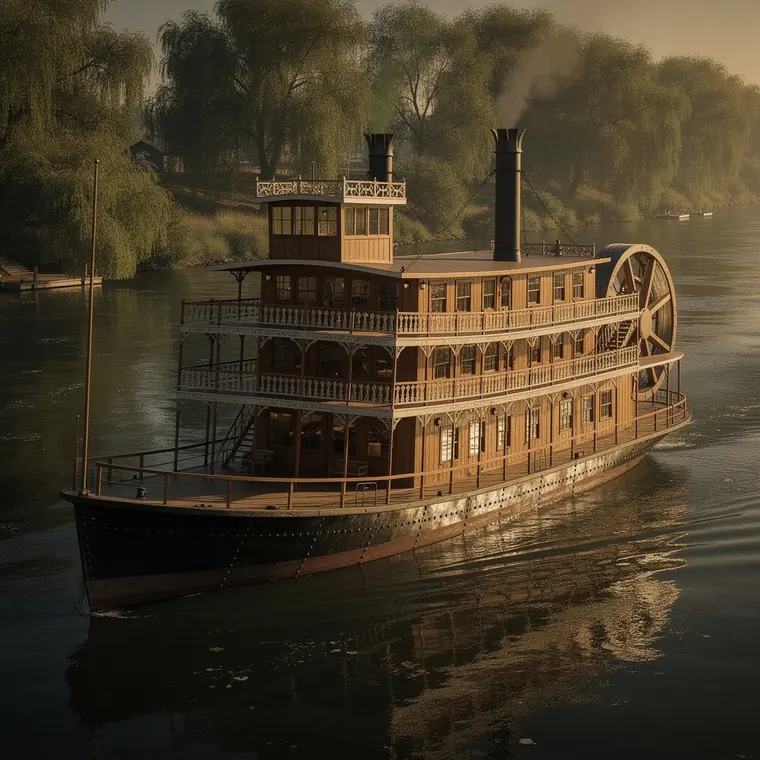
The riverboat Delta Queen on the Sacramento River, riveted steel hull carrying four wooden decks, single funnel amidships, enclosed stern wheel housing aft, willow banks and levees along the channel.
- What it was used for
- Her hull sections and machinery came from William Denny & Brothers on the Clyde; she was assembled at the Banner Island yard in Stockton, California, and christened and launched there on 20 May 1927; the cost was $850,000 per Steamboats.org, $875,000 per the University of Wisconsin. From 1 June 1927 she ran the California Transportation Company's overnight service between San Francisco and Sacramento, her last scheduled run on 29 September 1940. Navy service in San Francisco Bay followed, as a house boat (YHB-7) and from 1944 as a ferry (YFB-56) carrying troops. In 1946 Captain Tom Greene bought her for $46,250 and in 1947 had her towed through the Panama Canal to the Mississippi. The National Park Service nomination gives a register length of 250 feet and 234 passengers in 117 staterooms.
- What was new
- Technically she was a late survivor of an old type, not a pioneer. The Waterways Journal calls her 1947 delivery the most lengthy salt-water journey ever accomplished by a flat-bottomed sternwheeler — a claim made by that one source. What is genuinely singular is her legal position: after the Yarmouth Castle fire of 1965, Public Law 89-777 took effect on 2 November 1968, barring wooden superstructures on overnight passenger vessels. Since then the Delta Queen has sailed only under time-limited Congressional exemptions; the last lapsed on 1 November 2008 and a new one came only in December 2018. A ship built as a Californian luxury steamer was painted grey as a troop ferry — and today depends not on her engineering but on acts of Congress.
Further reading
- Delta Queen – National Register of Historic Places / NHL Nomination (NPS, 70000495)
- Delta Queen – Steamboats.org
- Daughter of a River Dynasty – The Waterways Journal, 19.07.2020
- Testimony of Rear Adm. J. A. Salerno, U.S. Coast Guard, Senate Commerce Committee (Public Law 89-777)
- Delta Queen receives congressional exemption to cruise again – Professional Mariner
- University of Wisconsin-Madison Digital Library: Delta Queen (Packet/Excursion boat, 1926- ) (Maschine von Denny, Dumbarton; Taufe Banner Island 20.5.1927; 875.000 Dollar je Boot; letzte Fahrt 29.9.1940; Navy 'painted drab gray')
- U.S. House Committee on Transportation, Fact Sheet H.R. 1961 (46 U.S.C. 3503: seit 1966 feuerhemmende Bauweise bei mehr als 50 Übernachtungspassagieren; Ausnahme lief am 1. November 2008 aus; neunmal verlängert)
- Maritime Executive: Delta Queen Steamboat to Resume Overnight Voyages (im Krieg 'painted in battleship gray', Truppen von den Piers zu den Transportern in der Bucht; neun Ausnahmen bis 2008; Gesetz Dezember 2018)
- Naval History and Heritage Command, DANFS: Delta Queen (YHB-7; ab 5.7.1944 YFB-56; Fährboot in der San Francisco Bay; 28.8.1946 aus der Navy-Liste gestrichen)