Great Western
1838 · Wooden Paddle Steamer · Work 175 of 1,871
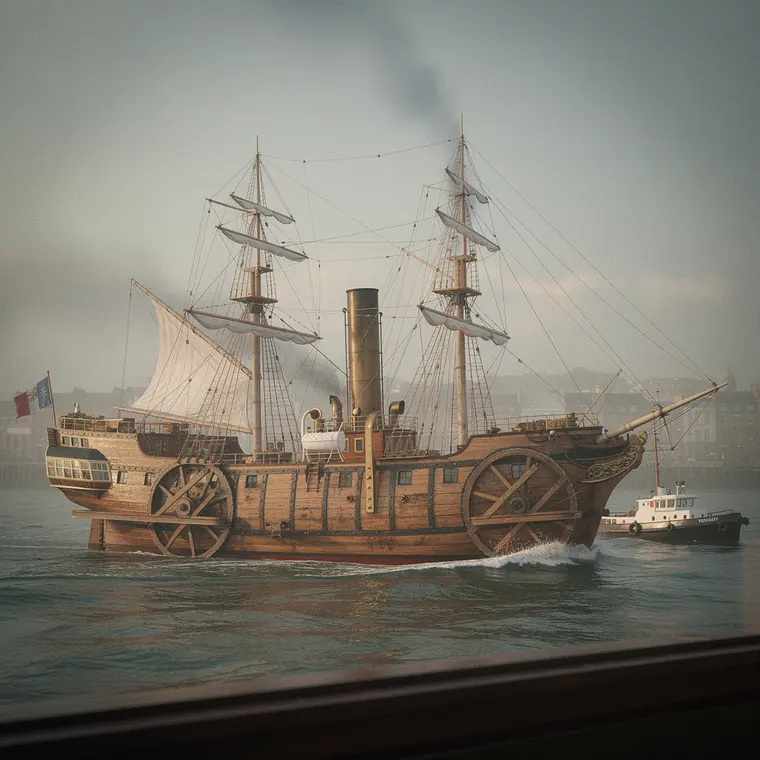
Brunel's Great Western steaming out of Bristol: an oak hull strapped and bolted with iron, one single large paddle wheel on each side amidships, each enclosed in its own paddle box, one wheel per side only, the two paddle boxes exactly opposite each other, a single funnel standing between and above the two paddle boxes, four masts with schooner rig, the bow well ahead of the paddle boxes and the stern well behind them, side lever engines within, tug alongside.
- What it was used for
- A wooden paddle steamer of the Great Western Steamship Company, founded in 1836, built by Patterson & Mercer at Bristol and launched on 19 July 1837. She worked the Bristol–New York line; her maiden voyage ran from 8 to 23 April 1838. In eight years she made 45 Atlantic crossings for her owners, averaging, per Grace's Guide for 1838–1840, 16 days westbound and 13 days 9 hours eastbound. Sold in 1847 to the Royal Mail Steam Packet Company, she then served the West Indies and South America, carried troops in the Crimean War, and was withdrawn in August 1856 to be broken up at Castle's yard, Vauxhall, on the Thames.
- What was new
- She was not the first ship to cross the Atlantic under steam: the Savannah did so partly under steam in 1819, and the Sirius reached New York a day ahead of her in April 1838. What was new was a ship purpose-built for scheduled Atlantic steam service that made the passage with margin to spare: Grace's Guide gives 8.66 knots against the Sirius's 8.03, and 200 tons of coal still aboard on arrival. She carried hardly any passengers: after a boiler-room fire before departure only 7 of 57 booked stayed aboard, the MIT Museum says; the 148 Britannica gives is her passenger capacity. The barb: when her sister Great Britain grounded in Dundrum Bay in 1846, the cost of the salvage bankrupted the company.