Great Britain
1843 · Iron Screw Steamer · Work 176 of 1,871
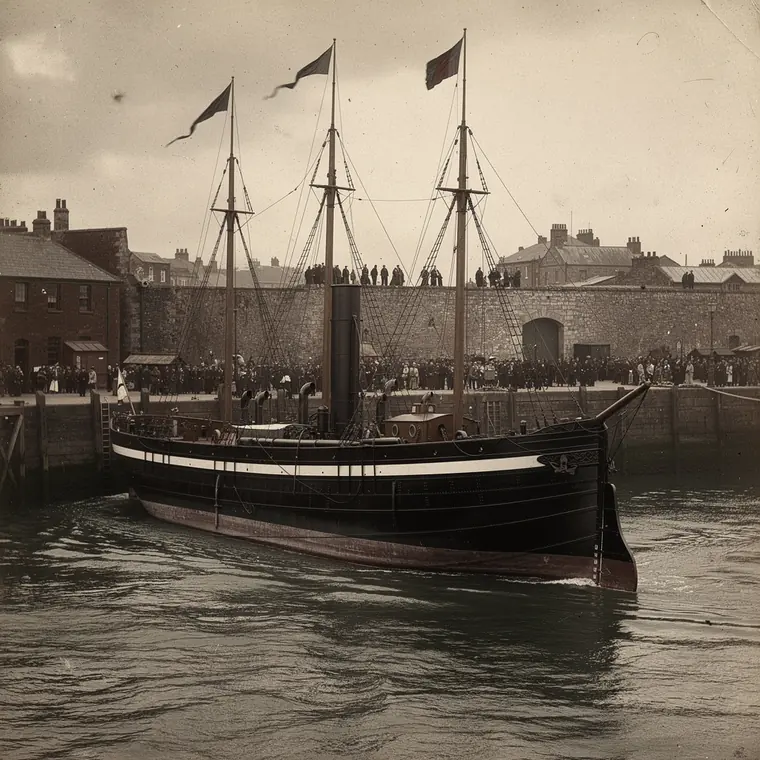
The iron ship Great Britain floated out of her dock at Bristol, her hull afloat and sitting deep in the water of the dock basin with the waterline high on the black hull, a single white stripe along its length, six masts and one funnel amidships, the stern with its balanced rudder in the water and only the rudder head showing above the surface, the water lapping the hull all round, her underwater body entirely hidden, crowds packed along the dock walls, flags on the masts.
- What it was used for
- Brunel's iron screw steamer for the Great Western Steamship Company, named by Prince Albert at Bristol on 19 July 1843. Her maiden voyage to New York began on 26 July 1845: some 3,100 miles in under 15 days. After grounding in Dundrum Bay in 1846 and being refloated in 1847, she was sold to Gibbs, Bright & Co. in 1850, entered the Australian emigrant trade in 1852 and carried an estimated 25,000 passengers over the years; from 1854 to 1857 she also served as a troopship in the Crimean War and the Indian Rebellion. Converted in 1882 into a pure sailing vessel for coal and wheat, she ended as a hulk in the Falkland Islands and was brought back to Bristol in 1970, where she lies today in her original building dock.
- What was new
- She too was not the first steamship across the Atlantic. What was new was the combination: Royal Museums Greenwich describes her as the first large iron ship built as a transatlantic liner and the first to be screw-propelled. Her dimensions are disputed — National Historic Ships UK gives 3,443 gross tons and a 50.95-foot beam, Royal Museums Greenwich 2,936 tons and 48 feet. The barb lies in the second half of her life: the celebrated prestige liner spent by far the longest part of her career as an emigrant ship, then a cargo sailer, and finally a coal hulk — and so lasted long enough to be saved.
Further reading
- ss Great Britain – National Historic Ships UK
- SS Great Britain (1843) – Royal Museums Greenwich
- Great Western Steamship Co – Grace's Guide
- Grace's Guide: SS Great Britain (Stapellauf 19.7.1843; New York 26.7.1845; Dundrum Bay Nov. 1846; Bergung Aug. 1847; Kauf durch Gibbs, Bright & Co.; 1852 erste Fahrt nach Melbourne mit 630 Auswanderern; 1882 Segler; 1970 Bristol)