Great Eastern
1858 · Paddle and Screw Steamer · Work 177 of 1,871
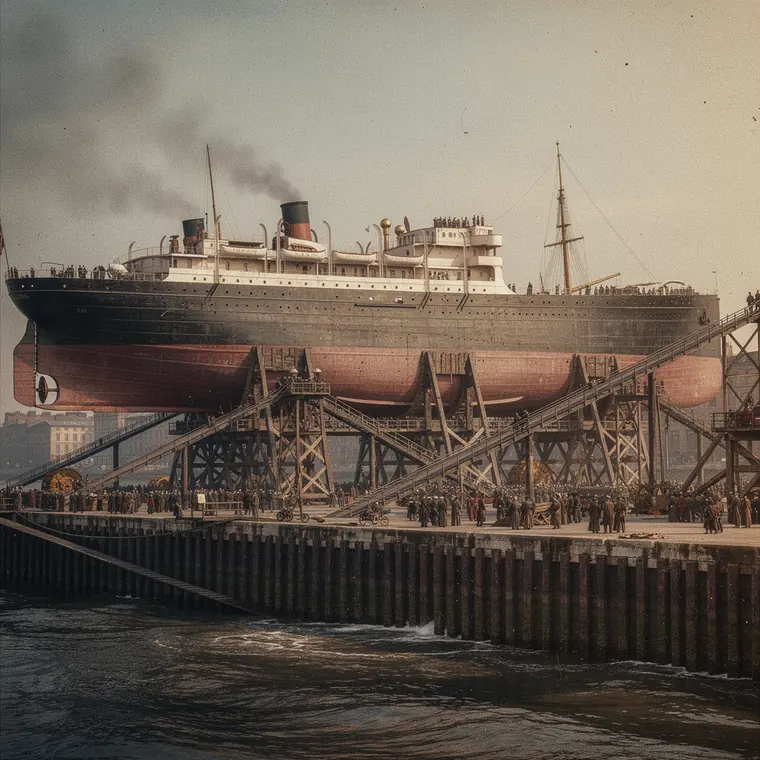
The Great Eastern held broadside on the Thames bank at Millwall during her sideways launch: the immense iron hull lying parallel to the river on two timber cradles on inclined launch ways, her side toward the water, five funnels in a row and six masts along her length, a great paddle wheel housing on her side, the hull resting on the cradles and the ways alone, enormous chain drums at the head of each way with chains running to the hull and hydraulic rams pressing against the iron hull at bow and stern, crowds of onlookers along the yard.
- What it was used for
- The design was for a ship carrying 4,500 passengers and 6,000 tons of cargo to India or Australia without coaling en route — with bunkers for 12,000 tons. On the North Atlantic she ran empty: her 1860 maiden voyage carried 35 passengers against a crew of 418, her holds were never filled, and in 1864 she was sold after years of deficit operation. Gooch, Brassey and Pender paid £25,000 and chartered her to the Telegraph Construction and Maintenance Company as a cable ship. In that role she was irreplaceable: in 1866 she sailed on 13 July and reached Heart's Content, Newfoundland, on 27 July, then recovered the cable end lost in 1865.
- What was new
- Her size was the difference: no other ship could take 2,600 miles of cable in one load and pay it out without transhipment — in 1865 the cable parted and was lost, in 1866 it held. The figures for the ship herself still contradict each other, sometimes within one institution: Royal Museums Greenwich gives 692 feet on one page and 680 on another; the contemporary handbook Ocean Steamships (1891) also says 680 feet and dates the launch to 30 rather than 31 January 1858. The barb: on 9 September 1859, two days out, a heater attached to the paddle-engine boilers exploded for want of safety valves, killing six firemen. Brunel had visited the ship shortly before, collapsed with a stroke, and died on 15 September.
Further reading
- Building the 'Great Leviathan' – Royal Museums Greenwich
- Great Eastern (1858), Liner – Royal Museums Greenwich
- The Explosion on board the Great Eastern Steam Ship, 1859 – Royal Museums Greenwich
- How perseverance laid the first transatlantic telegraph cable – Science Museum
- Great Eastern – Atlantic-Cable.com (Cableships)
- Ocean Steamships (1891), Project Gutenberg
- Pembrokeshire Historical Society: The visit of the Great Eastern to Neyland 1860-62 (Jungfernfahrt 17.6.1860 mit 418 Mann Besatzung und 35 Passagieren, 10 Tage 19 Stunden)
- Royal Museums Greenwich: Great Eastern (Brunels letzte Besichtigung und Schlaganfall an Bord 5.9.1859; Probefahrt ab 7.9.; Explosion eines Vorwärmers an den Kesseln der Schaufelradmaschine 9.9., sechs Heizer tot; Brunels Tod 15.9.1859; Verkauf 1864; Abbruch 1888)