Persia
1856 · Iron Paddle Steamer · Work 179 of 1,871
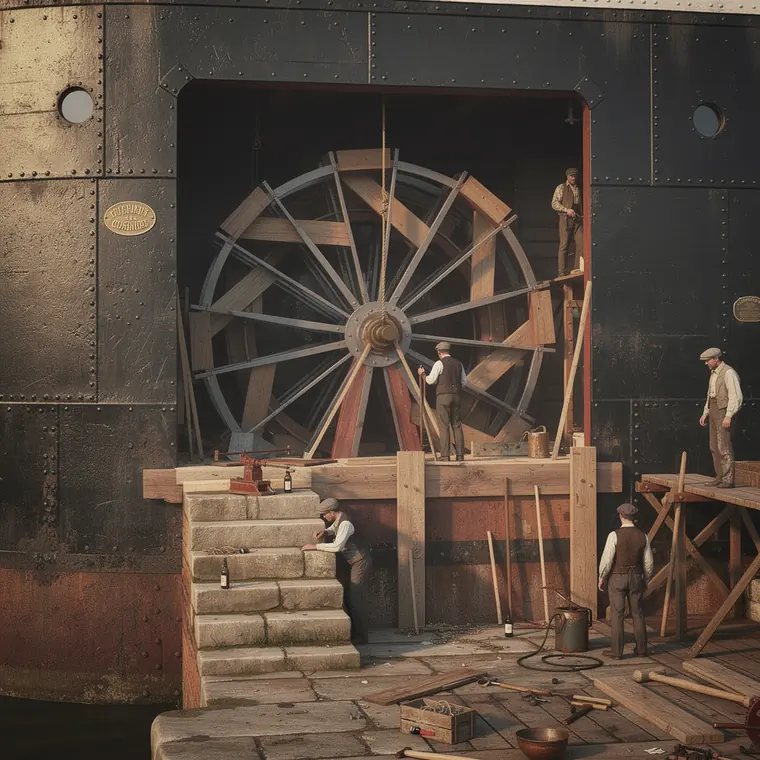
The starboard paddle wheel of the Cunard steamer Persia standing in a Liverpool graving dock, an iron wheel with radial iron spokes and rows of flat wooden floats fixed across the rim, plain planks of timber only, seen inside the opened paddle box against the riveted iron hull, shipwrights on timber staging, the men in cloth caps, waistcoats and shirtsleeves with hand tools, stone dock steps and timber shores.
- What it was used for
- An iron paddle steamer built by Robert Napier & Sons in Glasgow for Cunard, launched in July 1855 and entering the Liverpool–New York mail service on 26 January 1856. The GG Archives fleet list gives 200 cabin and 50 second-class passengers. Ocean Steamships (1891) gives cylinders of 100½ inches diameter and 120 inches stroke, 3,600 indicated horsepower at 33 lb boiler pressure, and 1,400 tons of coal for a transatlantic voyage. In 1861, during the Trent affair, she was chartered to rush troops to Canada.
- What was new
- Chris Frame's Cunard page calls her the first Blue Riband record-breaker built of iron — that is, the switch from wood to iron in the express service, not the iron hull itself, which was long established. At her maiden voyage she was the largest ship in the world. Her dimensions are disputed: 398 feet and 3,300 gross tons in two accounts, 376 feet and about 5,500 tons displacement in Ocean Steamships of 1891, 360 feet and 3,414 tons in the GG Archives. Royal Museums Greenwich dates the record passage to July 1856; The Great Ocean Liners gives an average of over 13 knots and has Scotia break the record in 1863. The barb: the type she crowned was finished within a decade. Cunard withdrew her from the North Atlantic in 1867 and she was scrapped in 1872, the Blue Riband having passed to rival screw steamers.
Further reading
- Persia – Chris Frame's Cunard Page
- Ocean Steamships (1891), Project Gutenberg
- Scotia (I) – The Great Ocean Liners
- Cunard Line – History of their Fleet (titanicandco.com): Persia von Robert Napier & Sons, Stapellauf 25.7.1855, 3.300 BRT, 398 Fuß; Servia erster Stahl-Cunarder, 7.392 BRT, 515 Fuß
- GG Archives: Cunard Line Fleet List (Persia: Napier, 3.414 t, 360 x 45 Fuß, 200 Kabinen- und 50 Passagiere zweiter Klasse, Jungfernfahrt 26.1.1856, Abbruch 1872; Servia: 450/600, 26.11.1881, Verkauf Okt. 1901)
- Royal Museums Greenwich Prints: British & North American Royal Mail Steam Ship 'Persia' (1855), Plan von David Kirkaldy (Napier & Sons; erstes Eisenschiff für Cunard; Blaues Band Juli 1856, gehalten bis 1862)
- British Light Infantry Regiments: The Trent Affair of 1861 (Truppentransport nach Kanada; Persia als einziges Schiff den St.-Lorenz hinauf bis Bic, ehe das Eis kam)