Servia
1881 · Steel Liner · Work 180 of 1,871
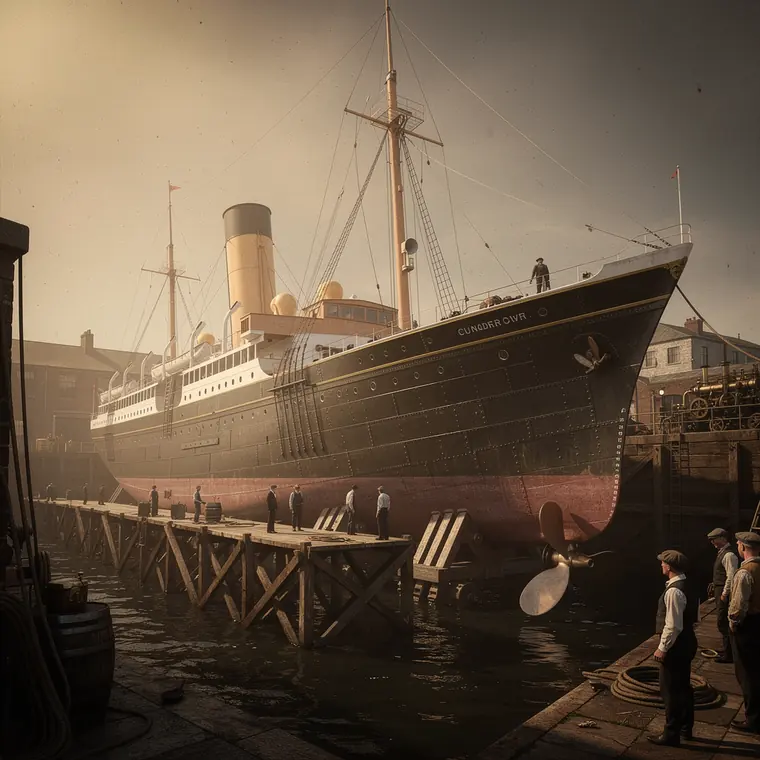
The Cunarder Servia resting in a Liverpool graving dock, a long steel-hulled steamship with the masts and funnel of a barque-rigged steamer, her steel hull plating and bilge keels exposed above the dock floor, single four-bladed screw and rudder above the dock blocks, workers on timber staging around the stern in cloth caps, waistcoats and shirtsleeves.
- What it was used for
- A Cunard liner from J. & G. Thomson of Clydebank, maiden voyage Liverpool–New York on 26 November 1881. GG Archives gives 450 first-class and 600 third-class berths with a crew of about 200. Displaced by Campania and Lucania in 1893, she moved to the intermediate service and carried troops to South Africa in the Boer War; her end is given either as a sale in October 1901 or as breaking up by Thos. W. Ward in 1902. She had been built to Admiralty specification so that she could be requisitioned as an armed auxiliary cruiser in wartime — which never happened.
- What was new
- Two innovations are credited to her, and both need narrowing. Electric light: she was the first Cunarder to have it, but not the first ship — the City of Berlin had a small installation in 1879, and the Columbia received a larger one from Edison in 1880, counted as the first commercial use of incandescent lamps outside his Menlo Park laboratory. The steel hull: most accounts call her the first large liner built of steel rather than iron, while Chris Frame's Cunard page calls her flatly "their first iron-hulled liner". That contradiction is unresolved. The barb lies in a third claim: the caption to her model in the Science Museum calls her the first truly modern specialised passenger liner with only the minimum of cargo space — yet the trade press of the day (The Engineer, 11 November 1881) credits her with 6,500 tons of cargo capacity on 8,500 tons gross.
Further reading
- SS Servia – Grace's Guide (zitiert The Engineer, 11.11.1881, S. 366)
- RMS Servia Archival Collection – GG Archives
- Maritime History: Columbia Lighting the World – MarineLink
- Servia – Chris Frame's Cunard Page
- Ocean Liners Magazine: Steel-Hulled Servia (Stapellauf 1.3.1881; erster Stahl-Cunarder; Glühlampen; 1893 nach Campania und Lucania in den Zwischendienst; Truppentransporter im Burenkrieg; Abbruch 1902)
- Science & Society Picture Library: ss 'Servia', 1881 (erster Cunarder mit elektrischem Licht; erstes Handelsschiff ganz aus Siemens-Stahl; 7.392 BRT; in der Admiralitätsliste der Hilfskreuzer; Transport im Burenkrieg 1899–1900; Abbruch 1902)
- Foto des Bildtexts zum Modell der RMS Servia im Science Museum (Flickr, camperdown): nur minimaler Frachtraum; 'first truly modern specialised passenger ocean liner'; nach Admiralitätsstandards für Hilfskreuzer gebaut, nie umgerüstet; Truppenschiff im Burenkrieg
- Great Ships: City of Berlin (1879 als erster Nordatlantikdampfer mit elektrischem Licht: vier Lampen im Salon, zwei im Zwischendeck; 1887 durchgehend)
- ETHW (IEEE): Edison's Electric Light and Power System ('The very first commercial Edison electric incandescent light installation took place on the S.S. Columbia in 1880')