Kaiser Wilhelm der Grosse
1897 · Four Funnel Liner · Work 181 of 1,871
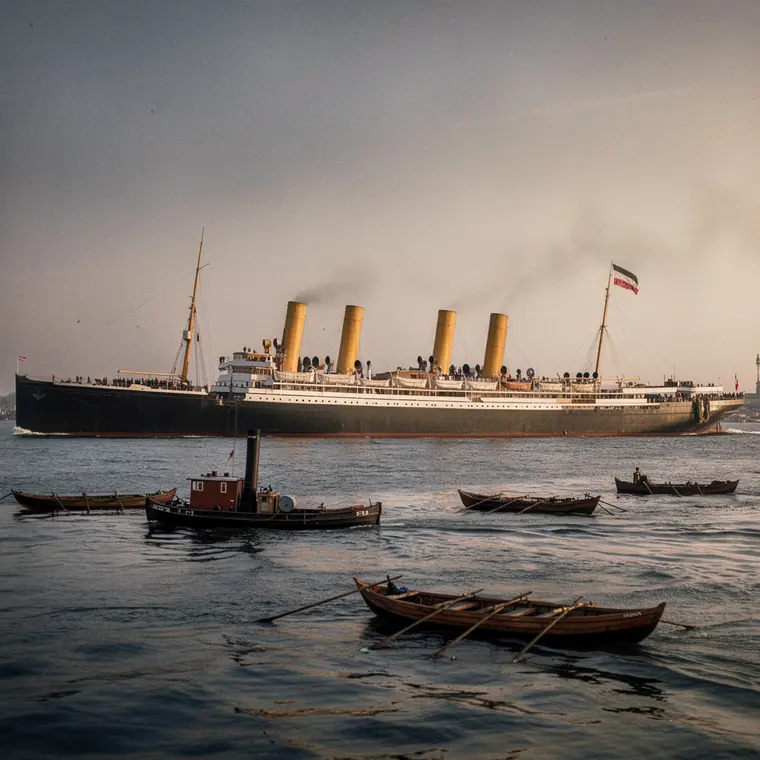
The ship of the reference image with her funnels exactly as there, a four-funnelled express steamer of 1897 seen broadside steaming out of Bremerhaven, exactly four tall buff-yellow funnels in a row along her length, arranged as two pairs, the first and second funnel close together, then a wide gap amidships, then the third and fourth funnel close together, all four funnels the same height and all four trailing coal smoke, two bare pole masts, at her stern one large flag of three horizontal stripes, black on top, white in the middle, red at the bottom, the same black-white-red flag small on the tug, straight vertical stem, black hull with plain unmarked plating, white superstructure, one small steam tug of the 1890s with a tall thin black funnel and an open deck, and open wooden lighters under oars, following in her wake, every hull plain and unmarked, warm low evening light.
- What it was used for
- A Norddeutscher Lloyd express liner built by Vulcan of Stettin, maiden voyage 19 September 1897 from Bremerhaven via Southampton to New York. In the Deutsches Schiffahrtsarchiv, Arnold Kludas gives 14,000 gross tons and 22 knots and calls her the largest ship in the world on entering service. Passenger figures differ: GG Archives gives 332 first-class, 343 second-class and 1,074 third-class berths. In the winter of 1906/07 she ran, per the Lloyd bulletin at GG Archives, between Genoa, Naples, Gibraltar and New York, and in January 1907 made a Mediterranean cruise out of New York, per Norway Heritage; in 1913/14 she was rebuilt as an all-third-class ship to carry emigrants.
- What was new
- No passenger ship before her had four funnels; for the next decade, as The Great Ocean Liners puts it, they became the mark of size and safety without being technically necessary. In February 1900 Marconi's Wireless Telegraph Company installed here the first commercial wireless telegraph on a passenger liner. The Polytechnisches Journal reported in 1900 a first Atlantic crossing of 5 days 22 hours 45 minutes, an average of 21.36 knots, and 32,000 indicated horsepower as the highest output recorded. The barb: the empire's prestige ship became an auxiliary cruiser on 4 August 1914 and was lost within three weeks. On 26 August she lay coaling off Río de Oro when HMS Highflyer appeared; Reymann steamed out to fight, ran out of ammunition and had the ship blown up — the British credited the loss to their gunfire.
Further reading
- Der Norddeutsche Lloyd und sein Doppelschraubenschnelldampfer 'Kaiser Wilhelm der Grosse' – Polytechnisches Journal, Bd. 315 (1900)
- Arnold Kludas, Die deutschen Schnelldampfer – Deutsches Schiffahrtsarchiv 4 (1981), Deutsches Schifffahrtsmuseum
- SS Kaiser Wilhelm Der Grosse Archival Collection – GG Archives
- SS Kaiser Wilhelm der Grosse – Ship Guide, OceanLiners.net
- The Sinking of the Kaiser Wilhelm der Grosse, 26 August 1914 – War and Security
- Kaiser Wilhelm der Grosse, Norddeutscher Lloyd – Norway Heritage (Marconi-Anlage Februar 1900 als erster kommerzieller Liner; Mittelmeer-Kreuzfahrt ab 26.1.1907; Umbau zum reinen 3.-Klasse-Schiff Nov. 1913 bis März 1914; 4.8.1914 Auslaufen als Hilfskreuzer; 26.8.1914 Rio de Oro)
- Kaiser Wilhelm der Grosse – The Great Ocean Liners (erstes Schiff mit vier Schornsteinen, 'symbol of size and safety'; Kohlen vor Rio de Oro am 26.8.1914, Gefecht mit Highflyer, Munition verschossen, Sprengung)
- Hansard, 27. August 1914: German auxiliary cruiser sunk by H.M.S. Highflyer (14.000 t, versenkt vor dem Rio de Oro)