Deutschland
1900 · Express Steamer · Work 182 of 1,871
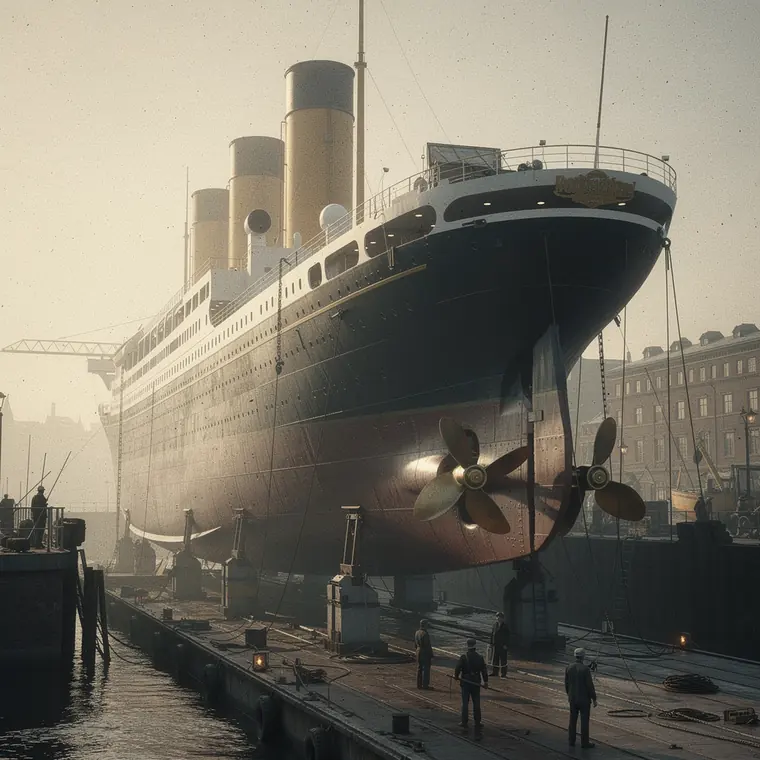
The liner Deutschland lifted in a Hamburg floating dry dock: the long steel hull standing dry on keel blocks, at the stern exactly two propellers, one four bladed screw on each side of the sternpost, both close under the counter and below the waterline mark, the balanced rudder standing behind them on the sternpost, four tall funnels in a row above the superstructure, dock workers spread across the pontoon floor beneath the hull.
- What it was used for
- A Hamburg America Line express liner built by Vulcan of Stettin in 1900, 16,502 gross register tons, quadruple-expansion engines on twin screws, per GG Archives 36,000 indicated horsepower from 16 boilers with 112 furnaces, cost $3,200,000. Per GG Archives she carried 690 first-class, 300 second-class and 280 third-class passengers (Norway Heritage: 467, 300 and 300) on the Hamburg–New York mail run. Norway Heritage records for 1900 a Plymouth–New York passage of 5 days 16 hours 46 minutes and a Cherbourg–New York passage of 5 days 12 hours 29 minutes, cut by September 1903 to 5 days 11 hours 54 minutes. She was taken off the line in 1910, returned in 1911 as the Victoria Luise, later became the Hansa (GG Archives: 1922, Norway Heritage: 1920) and was scrapped in 1925.
- What was new
- She was the only Hamburg America liner ever to hold the Atlantic record and the line's only four-funnel ship; Kludas classes her as a vessel of the Kaiser Wilhelm der Grosse type with which HAPAG outdid the Lloyd in the summer of 1900. The record figures themselves are uncertain: The Great Ocean Liners lists her westbound at 23.06 and later 23.15 knots, eastbound at 23.51; Norway Heritage gives 23 knots guaranteed and 22 in service, and the passage times differ between accounts by up to an hour. The barb: the speed was bought with vibration. Norway Heritage reports that she was unpopular with passengers and earned the nickname The Cocktail Shaker, and that the pitch of the propeller blades was later altered. In the conversion to a cruise ship boilers were removed and her speed fell to about 16½ to 17 knots.
Further reading
- S.S. Deutschland (3), Hamburg America Line – Norway Heritage
- SS Deutschland Archival Collection – GG Archives
- SS Victoria Luise Archival Collection – GG Archives
- The Blue Riband – The Great Ocean Liners
- Arnold Kludas, Die deutschen Schnelldampfer – Deutsches Schiffahrtsarchiv 4 (1981)
- Earl of Cruise: History – ss Deutschland, the only HAPAG four stacker and Blue Riband winner ('HAMBURG AMERICA's first and only four-stacker ship'; Hansa 1921; Abbruch Hamburg 1925)