Lusitania
1906 · Turbine Express Steamer · Work 183 of 1,871
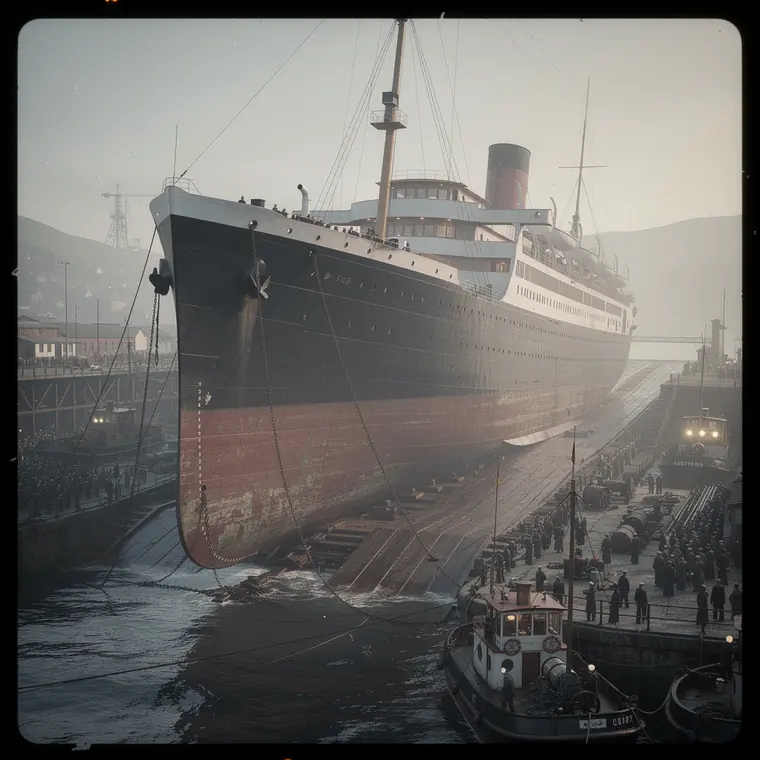
Lusitania sliding down the ways at John Brown's yard on the Clyde, the huge bare hull moving down greased timber ways that slope into the river, the hull resting on and travelling along the ground of the slipway, its stern already afloat and its bow still on the ways, the hull complete only to main deck level, drag chains piled along the bank, launch platform crowded with shipyard spectators, tugs waiting in the river.
- What it was used for
- A Cunard express liner from John Brown & Co., Clydebank, yard no. 367, first keel sections laid on 17 August 1904 (so Titanic & Co.; The Lusitania Resource gives 16 June 1904). She was designed for 563 first-class, 464 second-class and 1,138 third-class passengers, 2,165 in all, on 840 tons of coal a day with a complement of 827. She worked the Liverpool–New York mail run. On her last voyage of 1 May 1915 the Mersey report records only 1,257 passengers aboard — 290 first, 600 second, 367 third — with 702 crew; the wartime schedule no longer filled the ship.
- What was new
- For 25 knots, National Museums Liverpool notes, at least 60,000 horsepower was needed; reciprocating engines of that output would have taken up so much room that little space was left for passengers and cargo. Turbines did the same in less space — 68,000 horsepower, 26.4 knots on the trial run in July 1907, 25.85 knots average in 1909. Turbines had been to sea before: Parsons's Turbinia from 1894, the Allan liners Victorian and Virginian in North Atlantic service from 1905. Whether the Carmania–Caronia comparison decided the matter is disputed: National Museums Liverpool denies it outright, The Lusitania Resource calls the Carmania the trial ship for it. The barb: built with a £2.6 million state loan for two ships and an annual subsidy so that they could serve as auxiliary cruisers — a plan the Admiralty dropped over coal consumption, 910 tons a day. As a passenger ship she sank on 7 May 1915 in 18 minutes.
Further reading
- Lusitania: an engineering triumph – National Museums Liverpool
- Mersey Report, Annex 'The Ship' – The Lusitania Resource
- The Cunard Company (Admiralitätsvertrag 1903) – The Lusitania Resource
- 18 Minutes That Shocked the World – Imperial War Museums
- RMS Lusitania (1907): Sources – University of Glasgow Archive Services (John Brown, Clydebank, Yard No. 367)
- History Hub Ulster: RMS Lusitania (827 Mann Besatzung; 840 Tonnen Kohle am Tag; 563 erster, 464 zweiter, 1.138 dritter Klasse)
- Titanic & Co.: RMS Lusitania (Kiel 17. August 1904, Baunummer 367; Stapellauf 7.6.1906; Jungfernfahrt 7.9.1907)
- Construction and Trials – The Lusitania Resource (Kiel 16.6.1904; Probefahrt 27.7.1907 26,4 Knoten, 1.8. 26,7 Knoten; Heckvibration)
- Career – The Lusitania Resource (Westrekord 8.-12.8.1909 mit 25,85 Knoten; Mauretania 26,06 Knoten September 1909, Rekord 20 Jahre bis Bremen 1929)
- Conception and Design – The Lusitania Resource (Parsons: 68.000 PS für 25 Knoten; Carmania als Versuch, 1,5 Knoten schneller als Caronia)
- War – The Lusitania Resource (910 Tonnen Kohle am Tag; Admiralität verzichtet auf Requisition als Hilfskreuzer)
- Virginian – The Great Ocean Liners (Victorian und Virginian erste Turbinenliner auf dem Nordatlantik; Jungfernfahrt Virginian 6. April 1905)
- Grace's Guide: Turbinia (gebaut 1894, erste Probefahrt 14.11.1894, Vorführung Spithead Juni 1897)