Olympic
1910 · Ocean Liner on the Slipway · Work 185 of 1,871
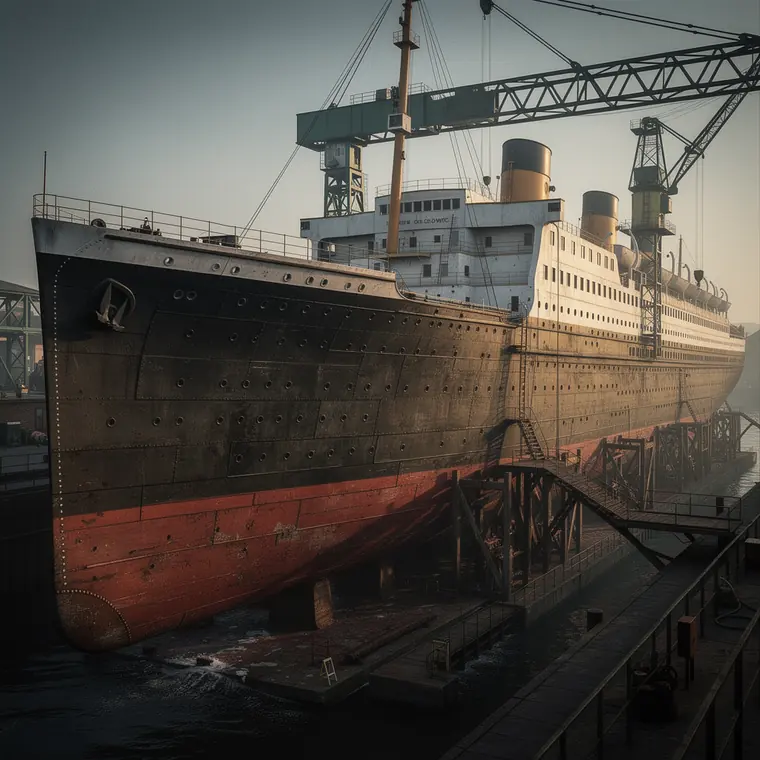
The hull of Olympic standing on the slipway at Harland and Wolff, riveted shell plating and empty portholes, the Arrol gantry with travelling cranes straddling the ship, timber staging along her side.
- What it was used for
- The first ship of the White Star Line's Olympic class, built by Harland & Wolff in Belfast, keel laid December 1908, launched 20 October 1910, maiden voyage Southampton–New York on 14 June 1911. GG Archives gives 1,054 first-class, 510 second-class and 1,020 third-class berths, 860 crew, and a cost of $7,500,000; on her maiden voyage she burned 650 tons of coal per 24 hours at an average of 21.7 knots. In the First World War she was a troopship: ten round trips Liverpool–Halifax between March and December 1916, some 72,000 Canadians in three and a half years and about 132,000 soldiers in all, with an official complement at times of 6,014 men per voyage.
- What was new
- What was new was the jump in size, not any single component — and what was changed afterwards tells more than what was new on delivery. After the loss of the Titanic she was first given 40 secondhand collapsible boats from troopships, then, in the 1912/13 refit, 64 wooden lifeboats stacked two high along the boat deck; the alterations raised her measurement to 46,359 or 46,439 tons — two sources, two figures that cannot be reconciled. In Halifax she was called Old Reliable for the regularity of her arrivals and departures, according to the journal Canadian Military History. The barb: the ship whose safety equipment came out of her sister's disaster rammed and sank the German submarine U 103 on 12 May 1918 — ten of its crew died, 35 survived.