Titanic
1911 · Ship Launch · Work 186 of 1,871
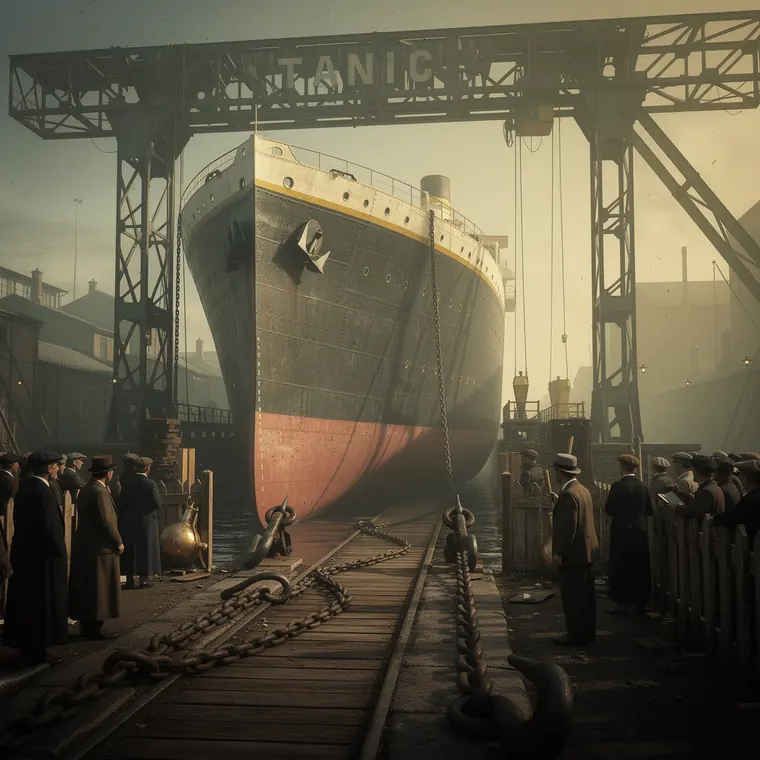
Titanic's bare hull running down the tallowed slipway at Queen's Island into the River Lagan, a plain riveted steel hull with no funnels or masts yet stepped and no superstructure, beneath the huge steel gantry that spans the slipways, drag anchors and heavy chains on the ground beside the ways, shipyard crowds behind timber barriers in flat cloth caps, bowler hats, dark suits and long skirts, only horse-drawn carts.
- What it was used for
- North Atlantic liner service, Southampton to New York, for the White Star Line; built by Harland & Wolff and registered at Liverpool at 46,328 gross tons (British Wreck Commissioner's Report, 1912). She was fitted out for 2,566 passengers. On the maiden voyage, leaving Southampton on 10 April 1912 shortly after midday, the same report counts 325 first-class, 285 second-class and 706 third-class passengers, 2,201 persons aboard including crew – more than half the fare-payers travelled third class. As a Royal Mail Ship she carried 3,364 mailbags, according to the Smithsonian National Postal Museum.
- What was new
- What was new was not the size but the combination machinery: two reciprocating engines exhausted into a low-pressure turbine, which "The Shipbuilder" of midsummer 1911 says allowed the steam to be expanded beyond the limit possible in a reciprocating engine – more power from the same steam consumption. The same journal says Harland & Wolff were "among the first" to do this, not the first; the yard had tested the arrangement in 1909 in the Laurentic against the reciprocating-engined Megantic. New too were the Welin quadrant davits: one pair could serve four boats instead of one. The naval architect Alexander Carlisle confirmed to the British inquiry in 1912 his press statement that this would have allowed over 40 boats. The capability was installed; it was not used.
Further reading
- British Wreck Commissioner's Inquiry, Report 1912 (Description, Machinery, Crew and Passengers, Board of Trade's Administration)
- The Shipbuilder, Midsummer 1911, Propelling Machinery (Reproduktion, GG Archives)
- British Wreck Commissioner's Inquiry, Tag 20, Zeugnis Alexander Carlisle
- Smithsonian National Postal Museum, Mail Ships
- Titanic Belfast, On This Day – 10th April 1912
- The Great Ocean Liners, Laurentic (I)