Imperator
1913 · Quadruple Screw Steamer · Work 187 of 1,871
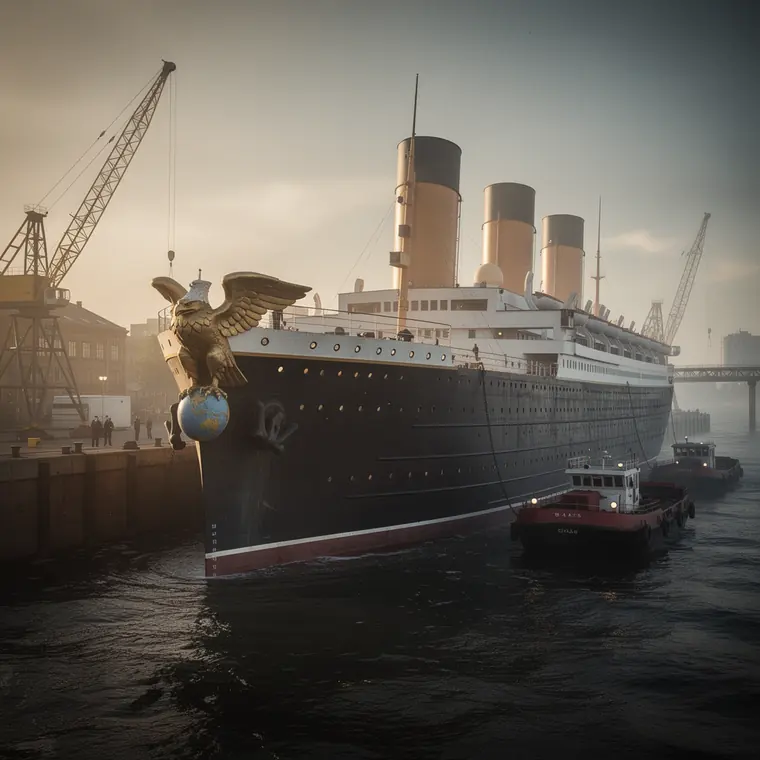
The liner Imperator fitting out at her Hamburg berth, three broad funnels, a great eagle figurehead clutching a globe over the bow, coaling barges and floating cranes worked alongside the quay.
- What it was used for
- North Atlantic liner of the Hamburg-Amerika-Linie, built by Vulcan at Hamburg for the Hamburg–New York run. In May 1913 "International Marine Engineering"gave berths for 700 first-class, 600 second-class, 940 third-class and 1,750 fourth-class passengers with a crew of over 1,000; the US Navy's 1919 ship's booklet gives 1,000 and 1,800 for the two lower classes – the figures are disputed. Fourth class was steerage, the volume trade. She carried an eagle holding a globe on her bowsprit, and in 1912 HAPAG advertised her in a booklet of its own as the largest ship in the world.
- What was new
- Four shafts with Parsons turbines of 70,000 horsepower, on owners' figures printed in "International Marine Engineering" in August 1912 – the same journal wrote of about 72,000 in May 1913 – for a design speed of 22½ knots, above anything afloat in 1912 in size, not in speed. The tonnage is disputed too: the same volume gives both 52,000 and 50,000 gross tons. Frahm anti-rolling tanks were fitted as standard. The barb: the largest ship in the world was the one that had to have weight taken out of her. She was top-heavy; marble panelling was replaced by wood, 2,000 tons of permanent ballast went in, the funnels were cut down, and the eagle was removed after storm damage. After the war she was handed over as reparations and sailed for Cunard.
Further reading
- International Marine Engineering, Bd. 17 (1912), S. 302 (Angaben der Reederei)
- International Marine Engineering, Bd. 18 (1913), S. 216
- A Brief History of the U.S.S. Imperator (1919), Project Gutenberg 43883
- Behörde für Schule und Berufsbildung Hamburg, Der Imperator – Das größte Schiff der Welt (Unterrichtsmaterial, zitiert HAPAG 1912)
- Naval Historical / shipscribe.com, Imperator (1913)