Normandie
1935 · Turbo-Electric Liner · Work 189 of 1,871
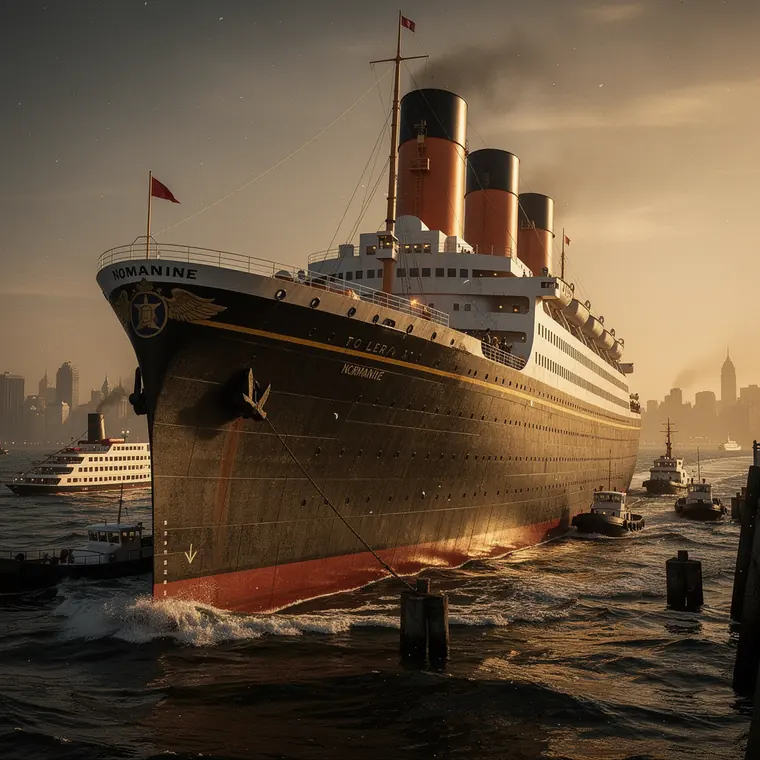
Normandie entering New York, clipper stem above a whaleback forecastle, three tapered funnels decreasing in height from forward to aft, tugs nudging her side, harbour ferries crossing ahead.
- What it was used for
- Liner of the Compagnie Générale Transatlantique, built at Penhoët near Saint-Nazaire for the Le Havre–Southampton–New York service. Accommodation for 1,972 passengers – 848 first, 670 tourist, 454 third – with a crew of 1,345. French Lines & Compagnies puts the building cost at an estimated 700 million francs and writes that state support kept the company from bankruptcy and liquidation by a narrow margin. She never carried troops: the Maritime Commission handed her to the Navy the day before Christmas 1941; on 9 February 1942 sparks from a welder's torch set light to life preservers, and the water poured in to fight the fire put her on her side at 2.45 a.m. on 10 February (US Navy, NHHC). One man died.
- What was new
- 160,000 horsepower, turbo-electrically transmitted to four screws, according to the cover of the special number of "The Shipbuilder and Marine Engine-Builder" for June 1935: steam turbines drove generators, electric motors drove the shafts. Added to this was Vladimir Yourkevitch's hull form with its knife-edge bow; the trade journal "Shipping Today & Yesterday" states that tank tests showed the same speed for almost 20 per cent less power. French Lines holds the "Brevet Yourkevitch" in its archive. The barb lies in the load factor: Harvey Ardman wrote in "American Heritage" in 1983 that Normandie carried no more than 1,972 fare-payers with 1,345 crew, while the Queen Mary carried up to 400 more passengers with 75 fewer crew. Even the tonnage was fought over, 79,280 to 86,496 gross tons.
Further reading
- Naval History and Heritage Command, DANFS, Lafayette (AP-53)
- French Lines & Compagnies, Normandie (C.G.T. 1935), Findbuch
- The Shipbuilder and Marine Engine-Builder, Juni 1935, Sondernummer Normandie (Titelblatt und Inhalt, via GG Archives)
- Harvey Ardman, The Ship That Died Of Carelessness, American Heritage 35/1 (Dezember 1983)
- Shipping Today & Yesterday, Vladimir Yourkevitch
- The Great Ocean Liners, Normandie (II)