Queen Mary
1934 · Turbine Liner under Construction · Work 190 of 1,871
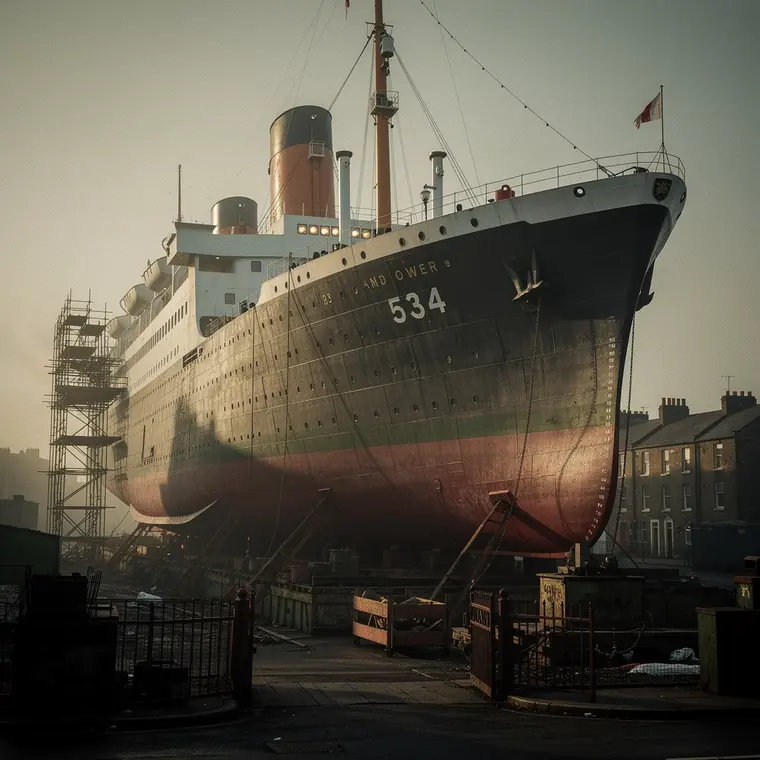
The hull of Queen Mary standing on the stocks at Clydebank as yard number 534, scaffolding and gantries rising on both sides, tenement rooftops crowding the yard gates, launch flags at the bow.
- What it was used for
- Cunard White Star express liner, built by John Brown at Clydebank for the Southampton–Cherbourg–New York service. The operator dates the keel laying to 1 December 1930, the launch to 26 September 1934 and the maiden voyage to 27 May 1936. She was finished with public money: in the Commons on 7 March 1934 Hore-Belisha named three million pounds to complete No. 534 and 1.5 million in working capital for the merger company. Sir Alfred Beit named the purpose in the same debate: only from England and France could a weekly express service be maintained with two ships of this speed. The operator counts 2.2 million passengers in peacetime and 810,000 military personnel in the Second World War.
- What was new
- She could hold the 30 knots of the turbo-electric Normandie with conventional geared turbines – 200,000 shaft horsepower on four screws, without the electrical detour – and, on Harvey Ardman's figures, carry up to 400 more passengers with 75 fewer crew. The barb is in her trooping service: on 2 October 1942, zigzagging at about 28 knots, she ran into her own escorting cruiser HMS Curacoa, and steamed on under orders not to stop under any circumstances. The casualty figures differ – 338 dead out of 439 and 99 saved in John Edwards's account in "Ocean Liners Magazine", 339 dead and 26 saved at naval-history.net. According to Edwards the court put two thirds of the blame on the Admiralty and one third on Cunard White Star. The operator records 70 tons of cement used to patch the bow.
Further reading
- Hansard, House of Commons, North Atlantic Shipping Bill, 7. März 1934
- Queen Mary (Betreiber), Timeline, Stats & Fun Facts
- John Edwards, Queen Mary – The Curacoa Tragedy, Ocean Liners Magazine, 2. Oktober 2020
- naval-history.net, British Warship Losses, Cruisers (HMS Curacoa)
- Harvey Ardman, The Ship That Died Of Carelessness, American Heritage 35/1 (Dezember 1983)
- The Queen Mary, Ship History