Rattler
1845 · Screw Sloop · Work 191 of 1,871
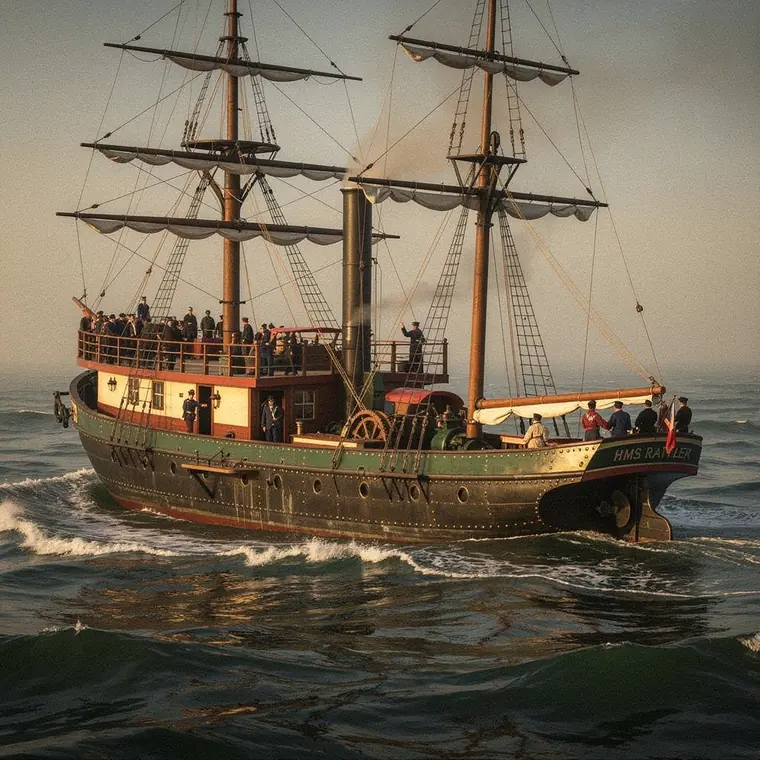
HMS Rattler and the paddle sloop Alecto lashed stern to stern in their tug of war off Orfordness, Rattler's screw dragging the paddler astern, naval observers crowding both quarterdecks.
- What it was used for
- Admiralty trials ship for screw propulsion; Grace's Guide records that she was used for extensive trials with a variety of propellers until October 1844. Regular service followed: anti-slavery patrols off West Africa, where it emerged that she could chase sailing slavers against the wind because the screw could be reconnected quickly; later the Second Burma War and anti-piracy work in the Far East, returning to Britain in 1856 and broken up at Woolwich. She is the fourth ship of the name.
- What was new
- Not the first screw ship: the Archimedes ran in 1839, the American Princeton in 1842–43 under Ericsson, Smith and Ericsson had patented in 1836, and the Naval Marine Archive calls Rattler only the "first screw-propelled vessel of the British Navy". What was new was the test series – the same hull with interchangeable propellers. John Ellis, citing Norman Rivett, gives six basic designs with six modifications to three propellers, 200 nominal and 437 indicated horsepower at 26 rpm; Grace's Guide and the IMarEST count 32 trials. The barb: the tug of war against Alecto on 3 April 1845 survived as proof, but the IMarEST calls it "more of a PR exercise" because the Admiralty was already showing confidence in the screw, and Cdr. Richard Morgan wrote in "Naval History" in 2025 that the results were "far more mixed".
Further reading
- Grace's Guide, HMS Rattler
- John Ellis, HMS Rattler (Naval Officers Association of Australia, nach Norman Rivett, The Naval Steam Reciprocating Engine)
- IMarEST, Battle of the paddles versus propellers
- Naval Marine Archive, Early propeller history
- Richard Morgan, Disruptive Technologies and Great Power Conflict, Naval History (USNI), Februar 2025