Warrior
1861 · Ironclad Frigate · Work 192 of 1,871
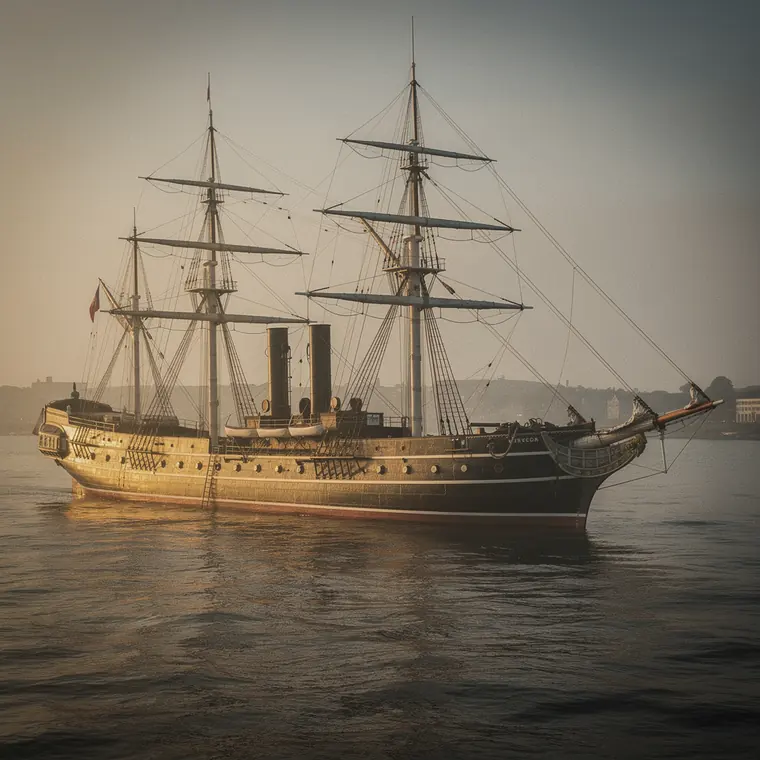
HMS Warrior lying at anchor at Spithead, long iron hull with a single row of gunports, full ship rig on three masts, two telescopic funnels lowered, boats swung out on davits.
- What it was used for
- Armoured frigate of the Royal Navy, built, in the words of Royal Museums Greenwich, in reply to the French Gloire of 1859. The same source says that precisely because of her superiority over anything afloat, she "never fired a shot in anger". Sea service with the Channel Fleet until 1872, then coastguard ship at Portland. National Historic Ships records her use as a hulk for torpedo stores from May 1901 to July 1902, then as a depot ship; paid off in 1924, converted to a floating oil jetty and towed in 1929 to Pembroke Dock, where she remained for the next 50 years.
- What was new
- The difference from the Gloire is not the armour but what carried it: the Gloire was a wooden hull cased in iron plate, Warrior an iron hull. The armour was 4.5 inches thick and, according to Rebecca Batley (Naval History Magazine, August 2022), was subjected to extreme testing. The barb: the same author writes that both ships had started to become obsolete within ten years of their launch. The ship that devalued every other was, on National Historic Ships figures, 22 years in service, six of them in full commission, then reserve ship, hulk and depot ship and, from 1924, some 55 years an oil jetty before an eight-year restoration at Hartlepool brought her back to Portsmouth in 1987. Sources give her length as 380 and as 388.75 feet; I could not confirm the building cost in any museum source.