Yermak
1899 · Icebreaker · Work 196 of 1,871
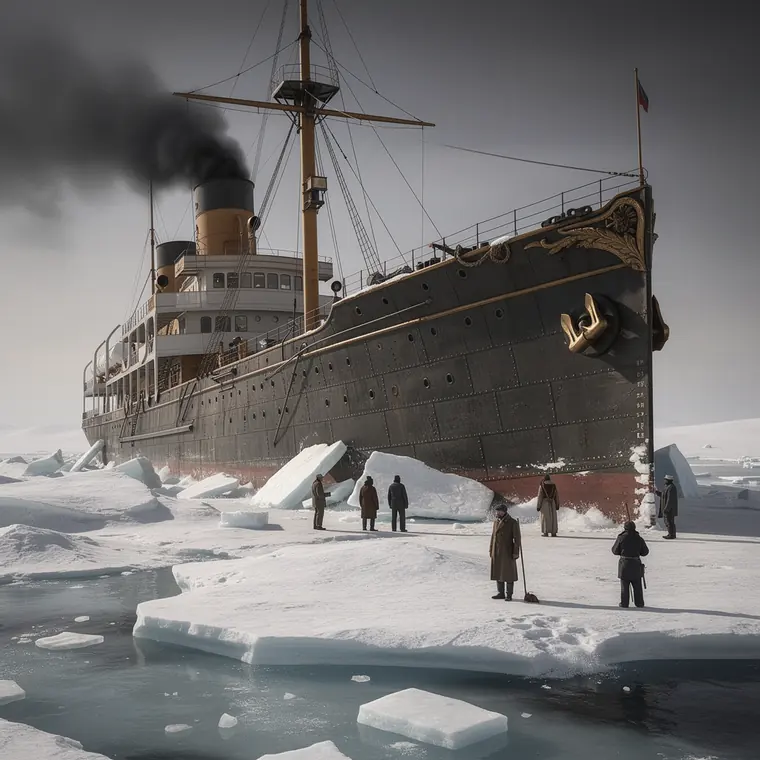
The icebreaker Yermak driving her spoon shaped bow up onto an Arctic ice field, the long sloping stem riding up over the ice and crushing it under her weight, a riveted steel hull with only her own deckhouses, funnels and masts on deck, black coal smoke from her funnels, slabs of broken floe tipping along the riveted hull, sailors standing out on the ice beside her.
- What it was used for
- Icebreaker built by Armstrong at Newcastle for Russia at the urging of Admiral Stepan Makarov; she reached Kronstadt on 4 March 1899 Old Style (16 March New Style). Her task was icebreaking in the Gulf of Finland and the Baltic for merchant shipping, later Arctic convoy work, and the salvage of ships stuck fast – the Central Naval Museum in St Petersburg names the cruiser Gromoboi and the coast defence ship General-Admiral Apraksin. The Arctic Council's PAME working group writes that Ermak and the Finnish Sampo "operated successfully in the Baltic". In service until 1963, broken up at Murmansk in 1964.
- What was new
- A wedge-shaped bow and a side flare of 20 to 22 degrees, where earlier icebreakers had 10 to 11 (PAME): the hull could ride up onto the ice and break it by weight, with heeling tanks to rock her free. PAME lists predecessors in numbers – Britnev's Pilot of 1864, the Hamburg-built Eisbrecher I of 1871, Swedish, Danish, Finnish and Norwegian boats of 1881 to 1890 – and the bow propeller came from the Great Lakes ferries St. Ignace and Ste. Marie. 9,000 horsepower; the displacement is disputed, GoArctic gives 8,730 tons, "The Engineer" of 20 October 1905 gives 7,000. The barb: she was built for Makarov's route to the Pole, which she never found. The bow propeller broke in multiyear Arctic ice and the whole arrangement was removed (PAME); the bow had to be strengthened after ice damage. She then did 64 years of harbour and convoy work, and PAME writes that development continued along her lines from 1900 to 1932.
Further reading
- PAME (Arktischer Rat), 2.6 History and Development of Arctic Marine Technology
- GoArctic.ru, Borez wo ldach: Eisbrecher Jermak
- Zentrales Marinemuseum St. Petersburg, Nachricht zum Eisbrecher Jermak
- The Engineer, 20. Oktober 1905 (Transkript bei Grace's Guide, Yermak (icebreaker))
- Tyne & Wear Archives & Museums, The icebreaker Ermack – a great Tyne-built ship