Eureka
1922 · Walking Beam Ferry · Work 197 of 1,871
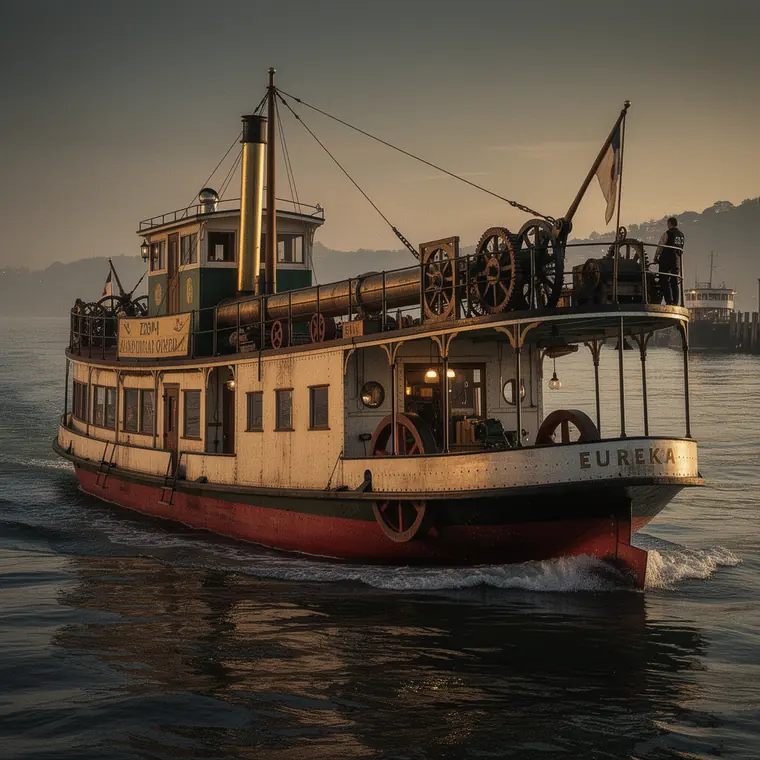
The ferry Eureka crossing San Francisco Bay, walking beam rocking above her deckhouse, wooden paddle boxes on both sides, ranks of commuters at the rail, ferry slips waiting ahead.
- What it was used for
- The hull began in 1890 as the railroad car ferry Ukiah; the National Park Service calls her "SF&NPR's 'tracks across the Bay'", ferrying trains to San Francisco – from Tiburon until 1909, only then from Sausalito (Haller). After the 1920–1922 rebuild she ran as an automobile and passenger ferry for the Northwestern Pacific: 2,300 passengers and 120 automobiles, where the 1890 hull had carried ten freight cars and 500 passengers (1922 figures from HAER CA-59, 1890 figures from Haller; HAER itself gives up to sixteen rail cars). In the 1984 National Register nomination Stephen Haller gives, for Ukiah, about 18,000 freight cars and 96,000 automobiles a year. Under Southern Pacific from 1941; her working career ended in 1957.
- What was new
- Nothing here was new, and that is exactly the point: the National Park Service's HAER documentation states that by the time Ukiah was built the walking beam engine was old technology – in California since the side wheel steamer Senator of 1849 – and that it was chosen because it was cheap to operate "and in EUREKA's case it already existed". What it could do: HAER notes that this type consumed less fuel than any other form of propulsion except the diesel-electric adaptations. Cylinder bore 65 inches, stroke 12 feet, 2,200 horsepower at 24 rpm (Haller, 1984; HAER records figures from 1,500 upwards). The barb: she was finished off not by a better ship but by two bridges – the Bay Bridge in 1936, the Golden Gate in 1937. And the end came in 1957 with a broken crank pin, of which HAER says "an easily repairable breakdown ended the ferry's working career". The date is disputed, 10 or 27 February 1957.