Eppleton Hall
1914 · Paddle Tug · Work 198 of 1,871
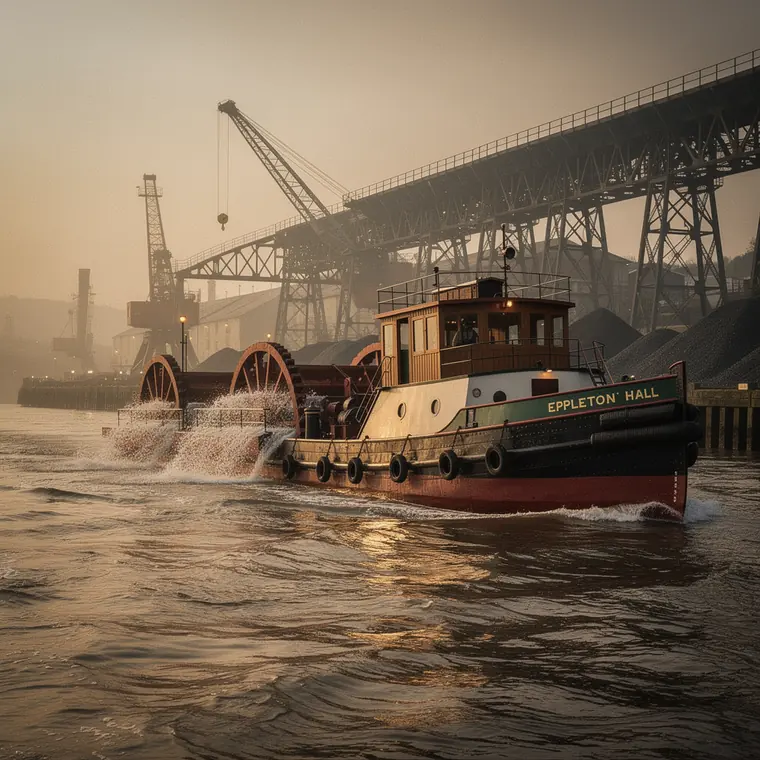
The paddle tug Eppleton Hall towing a loaded collier down the Tyne, feathering floats churning inside the paddle boxes, towing hook on the after deck, coal staithes and cranes along the bank.
- What it was used for
- Paddle tug, built by Hepple & Co. of South Shields for Lambton Collieries. The HAER documentation CA-63 records that she hauled ships of up to 4,500 tons up and down the River Wear, because the sea-going colliers were too unwieldy to navigate the rivers under their own power. In 1946 she passed to France, Fenwick, Wear and Tyne, and later towed barges at Seaham Harbour. Two engines of 30-inch bore and 51-inch stroke, generally worked at 20 to 30 psi, developing 500 horsepower between them.
- What was new
- By 1914 the type was already a survivor: HAER calls Eppleton Hall the second to last paddle tug built in Great Britain, the last being the John H. Amos, off the ways in 1930. What she could do, no screw tug could – the two engines worked independently of each other, one ahead and one astern, and the tug span round in very tight quarters. HAER says in the same passage what spoke against it: screw tugs were more powerful and more efficient, and their propellers less vulnerable to floating debris. The barb: in 1967 she had been sold for scrap and burned out on a mud bank, the fire being, as the National Park Service puts it, part of the scrapping process. The river tug then steamed 11,000 miles across the Atlantic from 16 September 1969 under Scott Newhall and passed through the Golden Gate in March 1970; HAER says the conversion for the voyage took three months.