Herschel Forty Foot
1789 · Reflecting Telescope · Work 201 of 1,871
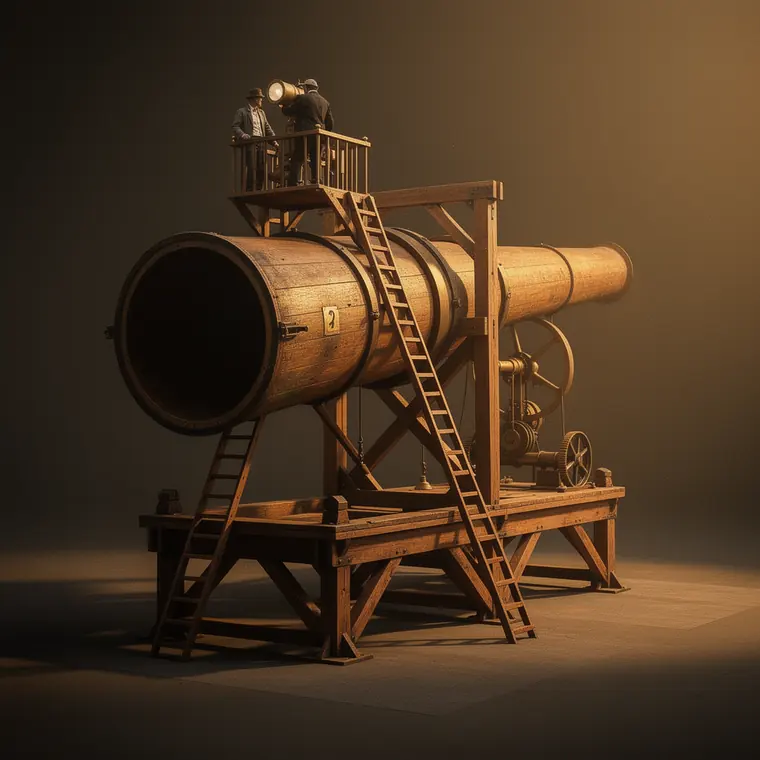
William Herschel's forty foot reflecting telescope at Slough, its wooden tube slung in a towering timber scaffold with ladders and winches, observing platform at the open mouth.
- What it was used for
- William Herschel began building it at the end of 1785; it stood in the garden of his house at Slough near Windsor. According to Royal Museums Greenwich, King George III paid a total of £4,000. It was meant to show fainter objects than Herschel's 20-foot instrument, which he used to sweep the sky systematically. Herschel sat at the top end of the tube; his sister Caroline, below, wrote down what he called through a speaking tube. On 28 August 1789 he found Saturn's moon Enceladus with it, and Mimas on 17 September. It was poorly suited to surveying: it was hard to move, and its mirror tarnished quickly. Royal Museums Greenwich date its last observation to 1815.
- What was new
- Its speculum-metal mirror had a polished surface 48 inches (1.22 m) across; no earlier telescope was this large, and none surpassed it until 1845. When it was finished is a matter of definition: Herschel recorded his first view through it on 19 February 1787, using a first mirror that had come out too thin. He counted it as finished only from the moon discovery of 28 August 1789, made with the second mirror. That is why museums give 1787 or 1789. Yet more aperture brought little more return. Both new moons were within reach of the 20-foot telescope too, Herschel himself wrote. Royal Museums Greenwich call the moon discovery the instrument's one achievement, and even that debatable.
Further reading
- W. Herschel: Description of a Forty-Feet Reflecting Telescope. Philosophical Transactions 85 (1795), 347–409 (Volltext Internet Archive)
- Royal Museums Greenwich: 40-foot Herschelian (reflector) telescope tube remains
- Royal Museums Greenwich: Mirror (zweiter Spiegel des 40-Fuß-Teleskops)
- Royal Museums Greenwich: The Herschel family and the Royal Observatory
- Science Museum Group: Original mirror for William Herschel's forty-foot telescope, 1785
- Kathleen Lundeen: On Herschel's Forty-Foot Telescope, 1789. BRANCH: Britain, Representation and Nineteenth-Century History
- University of Chicago Library (ECUIP): Great Forty-Foot Telescope
- NASA History: 235 Years Ago: Herschel Discovers Saturn's Moon Enceladus
- ESA: 28 August