Great Melbourne Telescope
1868 · Reflecting Telescope · Work 206 of 1,871
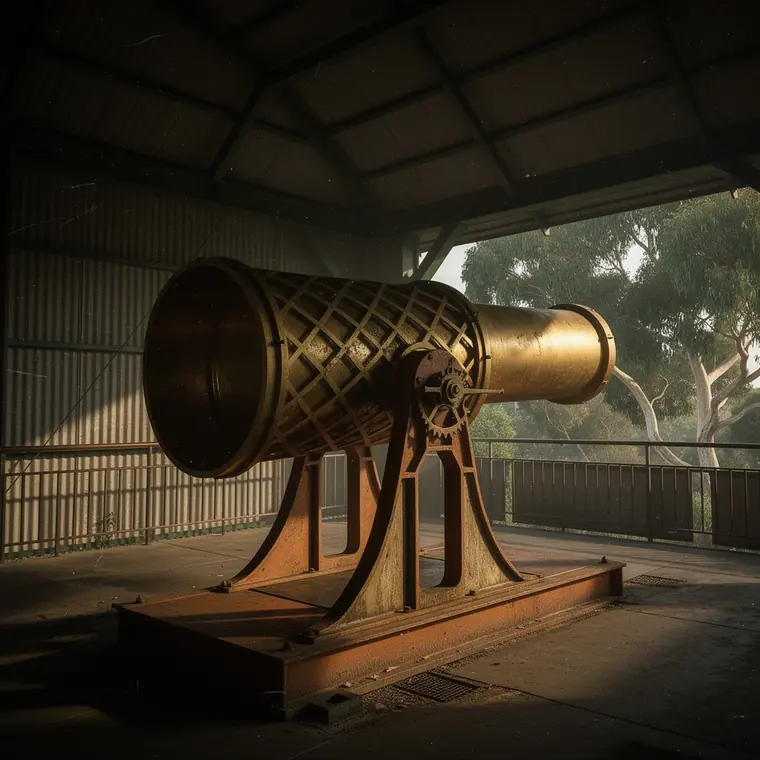
The forty eight inch Melbourne reflector in its open roofed shed at Melbourne Observatory, speculum metal mirror in a lattice tube, eucalyptus trees beyond the railings.
- What it was used for
- The telescope was meant to study the nebulae of the southern sky. Thomas Grubb built it in Dublin between 1866 and 1868, and it was erected at Melbourne Observatory in 1869; the colony of Victoria had voted £5,000 for it. Its metal mirror measured 48 inches (1.22 m). Observers such as Joseph Turner and Pietro Baracchi drew nebulae with it, according to Museums Victoria until 1892, after which it was used only intermittently. The mirrors tarnished constantly and flexed, and it was poorly suited to photography and spectroscopy; Museums Victoria says it never lived up to expectations. After the observatory closed (1944 or 1945, sources differ) it went to Mount Stromlo near Canberra, received a glass mirror and was rebuilt in the early 1990s for the MACHO project. In January 2003 a bushfire left it a distorted wreck. In 2008 the remains returned to Melbourne for restoration.
- What was new
- It was not the largest telescope: Lord Rosse's "Leviathan" in Ireland had had a 72-inch mirror since 1845. But the Leviathan hung between two walls and could follow an object on the celestial equator for only about an hour a night. The Melbourne instrument was equatorially mounted and could be swung freely across the sky; the UNESCO Portal to the Heritage of Astronomy calls it the largest fully steerable telescope in the world. According to the same portal, it was also one of the last large reflectors with a metal mirror of copper and tin before silver-on-glass mirrors took over. Its new freedom of movement thus came with a mirror technology that was already being replaced.
Further reading
- Museums Victoria Collections: Great Melbourne Telescope (Artikel)
- Museums Victoria Collections: Great Melbourne Telescope – 48-Inch Cassegrain Reflector, Thomas Grubb, Dublin, 1868
- Museums Victoria Collections: Thomas Grubb, Telescope Maker (1800-1878)
- UNESCO/IAU Portal to the Heritage of Astronomy: Melbourne Observatory, Australia
- The Irish Times: Designed in Ireland, assembled in Australia, pointed at the stars
- CAMD: Great Melbourne Telescope 1868 – Irish
- Great Melbourne Telescope Restoration Project, History
- BBC Sky at Night Magazine: The Leviathan's Legacy
- History Ireland: The Leviathan of Parsonstown