Kerguelen Venus Station
1874 · Observation Station · Work 207 of 1,871
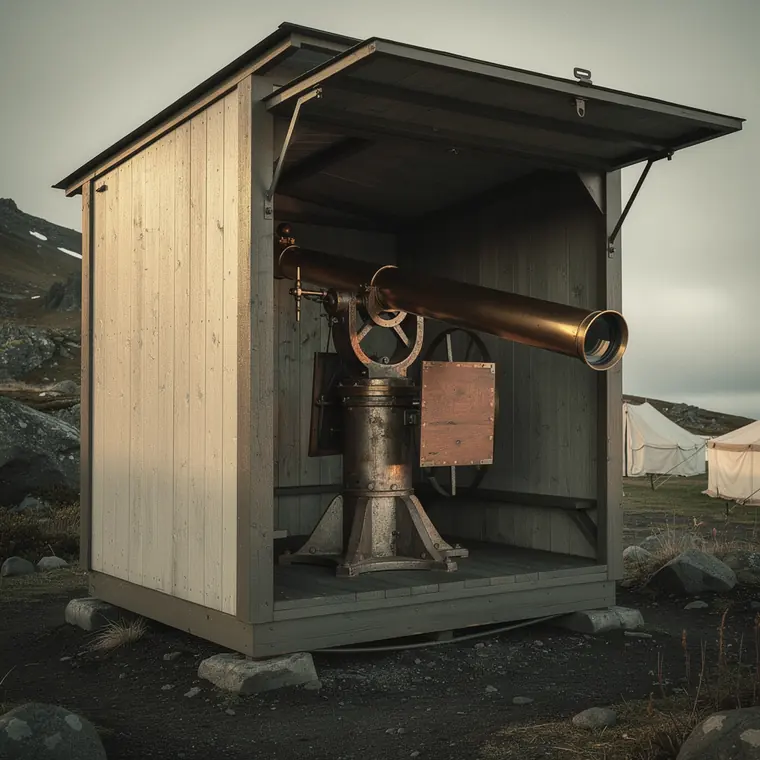
A British transit of Venus station on Kerguelen, portable wooden observing huts with sliding roofs, the photoheliograph a long straight telescope tube about eight feet long on an equatorial mounting on a solid pier inside its own hut, a plain lens at the sky end and a square wooden camera box holding the photographic plate at the lower end, the tube pointed at the sun, a tent camp on the treeless slope, grey sky and bare rock.
- What it was used for
- On 9 December 1874 Venus crossed the face of the Sun for about four and a half hours. Measurements from widely separated places were meant to yield the Earth–Sun distance. The corvette SMS Gazelle landed a German observing party under Carl Börgen at Betsy Cove on Kerguelen; it stayed on the island from 26 October 1874 to 5 February 1875. Besides the transit it recorded weather, geomagnetism and tides. The Germans were not alone: on the same island an American station at Molloy Point and British stations on Royal Sound observed the same event.
- What was new
- The German commission did not rely only on timing the moments of contact, which had produced widely scattered values at the 1868 transit of Mercury. Its main instrument was a heliometer, which could measure the separation of Venus from the Sun's centre throughout the transit rather than only at the instants of contact; photography and contact timing ran alongside as secondary methods. The scale was new as well: according to Ludendorff, 50 expeditions from several nations went out in 1874. Yet the German measurements gave a solar parallax of 8.80 arcseconds, which according to Herrmann still meant an error of about 200,000 km. The astronomer Emmanuel Davoust calls the results of 1874 and 1882 very disappointing, hardly better than those of the 18th century.
Further reading
- Cornelia Lüdecke: Die Routenfestlegung der ersten deutschen Südpolarexpedition durch Georg von Neumayer und ihre Auswirkung. Polarforschung 59 (3): 103–111, 1989 (erschienen 1991), Anhang 'Deutsche Messungen des Venusdurchganges von 1874 und 1882'
- Emmanuel Davoust: The journey of the German expedition to observe the transit of Venus on December 9, 1874 at the Kerguelen Islands and its sojourn there (nach L. Weinek 1911; frz. Original in Pulsar 733, 1999)
- Natural History of Kerguelen's Island. Nature 12, 35–37 (13. Mai 1875)
- Cambridge Digital Library: Transit of Venus (Royal Greenwich Observatory Archives)