Leeuwenhoek Delft Lens
1702 · Simple Microscope · Work 208 of 1,871
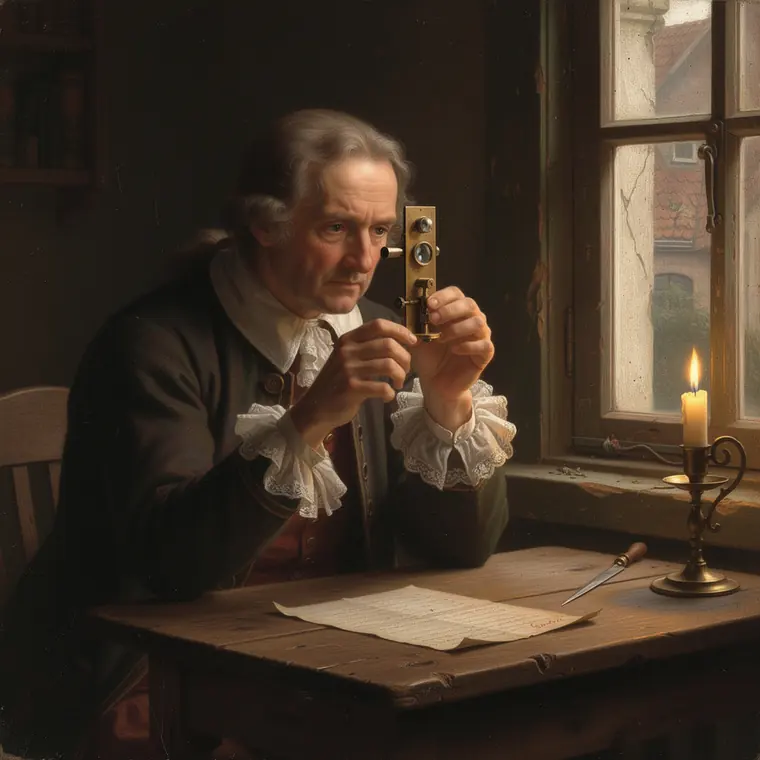
Antonie van Leeuwenhoek's single lens microscope held up to his eye in his Delft study, a device no longer than his thumb: two small flat brass plates riveted together with one tiny glass lens set in a hole between them, on the far side a slender pin carrying the specimen, three small screws moving the pin toward the lens and across it, held close against the eye toward the window light.
- What it was used for
- Antoni van Leeuwenhoek worked in Delft as a surveyor, wine-gauger and in the cloth trade; he built and used his microscopes himself. The device is a small brass plate holding a single tiny lens; the Utrecht example measures 2.5 × 4.6 cm. The specimen sat on a pin that screws moved in front of the lens and brought into focus. With it he examined blood, ditch water, plants and semen and described red blood cells, sperm cells and bacteria. He reported to the Royal Society in London by letter, 190 letters over fifty years according to the Society. On the year 1702: Leeuwenhoek neither signed nor numbered his microscopes; Utrecht University Museum only cautiously dates its example to possibly around 1700. No specific object from 1702 is documented.
- What was new
- What was new was the performance of a single tiny lens. The Utrecht example magnifies 266 times; according to Utrecht University Museum, comparable magnification with the same image quality was not achieved until the early 19th century. The museum calls it one of eleven surviving Leeuwenhoek microscopes, out of more than 500 he made. Leeuwenhoek kept his lens-making secret. Yet neutron tomography by Rijksmuseum Boerhaave and TU Delft (Cocquyt et al., 2021) showed that this strongest lens is a glass bead with a small glass stem, made by a method Robert Hooke had published in 1678. The other example examined, in Leiden, has a ground lens instead.
Further reading
- Universiteitsmuseum Utrecht: Het Van Leeuwenhoek microscoopje (Collectieverhaal)
- T. Cocquyt u. a. (Rijksmuseum Boerhaave, TU Delft): Neutron tomography of Van Leeuwenhoek's microscopes. Science Advances 7 (20), eabf2402, 2021
- Royal Society: Celebrating Leeuwenhoek (Blog, Juli 2023)
- Lens on Leeuwenhoek: 266x brass (Hintergrund, keine Museumsquelle)