Cuff Chest Microscope
1744 · Compound Microscope · Work 209 of 1,871
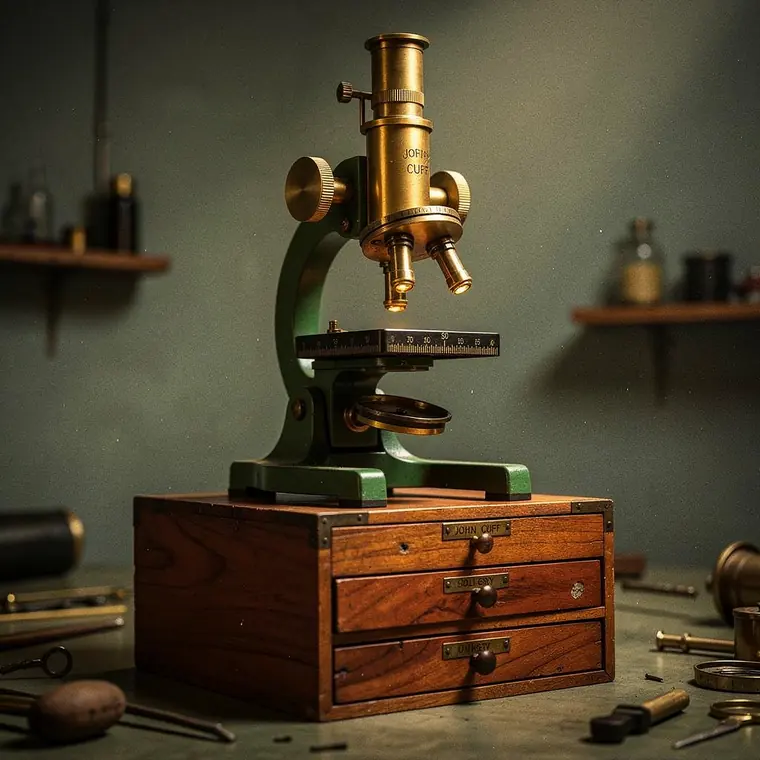
John Cuff's compound microscope on its fitted mahogany chest of accessory drawers in a London workroom, tall pillar body with rack focusing and a mirror below the stage.
- What it was used for
- London instrument maker John Cuff developed a new compound microscope around 1744/45 with the naturalist Henry Baker. Baker had complained that on the older Culpeper type the legs got in the way when moving the glass slips, and that the tube jerked when focusing. Naturalists and amateurs used it for prepared slides and living specimens; Baker illustrated Cuff's microscopes in his popular books. The example in the Whipple Museum, Cambridge (inv. 0885, c. 1745) stands on a box foot with a drawer and comes with six objectives, ivory sliders and part of a live box. The museums checked do not use the name "chest microscope"; it probably refers to this box foot. Cuff also made Culpeper-type microscopes, and his 1744 pamphlet describes a different instrument, a pocket microscope.
- What was new
- Cuff carried the tube and stage on a single side pillar instead of on legs as in the Culpeper type, so the cross-shaped stage could be reached by hand from all sides. The Whipple example also has a fine focus worked by a steel screw on the pillar; the sources checked do not show whether Cuff was the first to use such a fine adjustment. According to the Whipple Museum the model quickly became the most popular of its day, and according to the Golub Collection (UC Berkeley) it was copied within a few years in England, Italy, Holland and France. The Science Museum holds a German copy, possibly by Brander, and a "Cuff-type" microscope by the Dollonds dated 1790–1810. Cuff himself was declared bankrupt as early as 1750.
Further reading
- Whipple Museum of the History of Science: John Cuff and the 'New-Constructed' Microscope
- Whipple Museum Collections Portal: 0885, compound microscope, side pillar type, by John Cuff, c. 1745
- The Golub Collection, University of California, Berkeley: John Cuff microscope
- Science Museum Group: Cuff-type compound microscope, Dollond, 1790–1810 (A601261)
- Science Museum Group: Cuff microscope, German, possibly by Brander, mid 18th century
- John Cuff: The description of a pocket microscope ... London 1744 (Internet Archive)
- microscopehistory.com: Cuff's microscope (Datierung 1744, keine Museumsquelle)