Zeiss Apochromat
1886 · Microscope Objective · Work 210 of 1,871
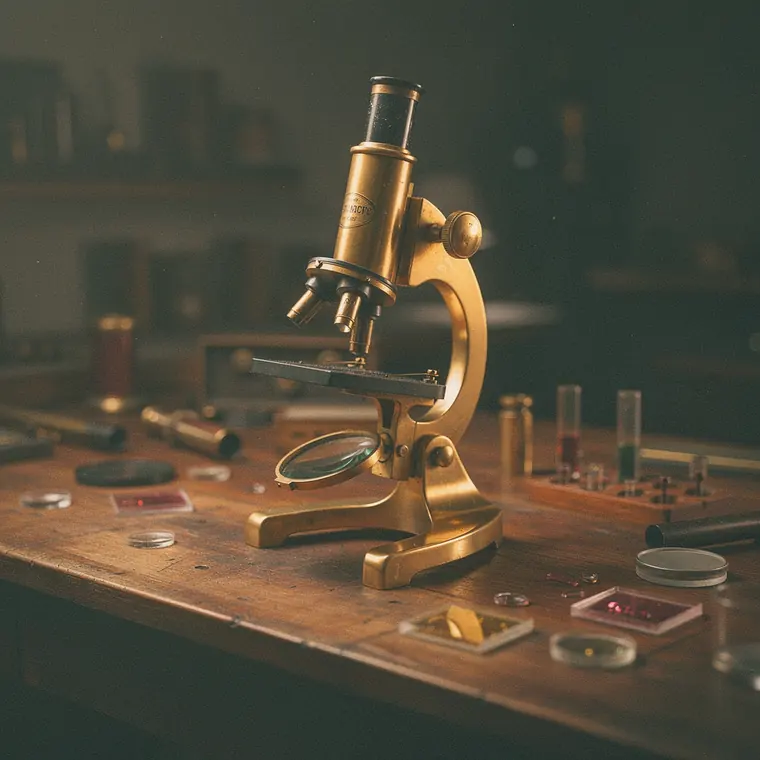
A nineteenth century brass microscope with a lacquered tube, horseshoe foot and mirror beneath the stage, standing on a workbench in an optical workshop among lens blanks and test slides.
- What it was used for
- The apochromat was a microscope objective with especially good colour correction, launched by Carl Zeiss in Jena in 1886 and computed by Ernst Abbe. It relied on glasses from the Glastechnisches Laboratorium Schott & Genossen, founded in 1884 with Prussian state support, and was sold with compensating eyepieces built to match. With ordinary achromats a colourless specimen detail still shows a greenish fringe at best focus; the apochromat was meant to remove that remainder. The 4 mm apochromat (aperture 0.95) cost 180 marks in the 1886 Zeiss catalogue. According to an 1890 catalogue supplement quoted by collector Fritz Schulze, some of the first units turned cloudy because certain new glasses decayed in use; Zeiss exchanged them and advised against humid tropical climates.
- What was new
- Achromatic objectives brought two colours, red and blue, to a common focus. According to Zeiss, Abbe's apochromat was colour-corrected for three wavelengths, made possible by glasses that Abbe and Schott had deliberately developed. Zeiss itself calls it the first apochromatic microscope objective. There was no patent on it: as Zeiss describes him, Abbe opposed patenting and only took out patents himself from 1890 on. Leitz made a 4 mm apochromat in 1892 that the Laupus Library at East Carolina University describes as almost an exact copy of an Abbe objective by Zeiss; because Abbe did not patent, it says, many of his designs were quickly copied.
Further reading
- ZEISS: Mikroskopie – wie alles begann (Technische Meilensteine, 1886)
- ZEISS: Microscopy – How it all began
- ZEISS: Ernst Abbe – Physiker, Erfinder, Unternehmer, Sozialreformer (Glaslabor 1884, Patente ab 1890)
- Deutsches Museum Digital: Glastechnisches Laboratorium Schott & Genossen … mit Unterstützung der Kgl. preuss. Staatsregierung gegründet 1884. Productions- und Preis-Verzeichniss
- Museum optischer Instrumente: Apochromat 4.0 mm mit Korrektur, Carl Zeiss Jena No. 21, 1886 (Preis 180 Mark nach Zeiss-Katalog 1886)
- Fritz Schulze: Examining 120-year old Zeiss Apochromats, Micscape, Oktober 2011 (zitiert Zeiss-Katalognachtrag 1890)
- Evident (Olympus): Optical Aberrations – Achromate zwei Farben, Apochromate drei Farben, sekundäres Spektrum
- Laupus Library, East Carolina University: Leitz 4mm Apochromat