Laennec Cylinder
1816 · Stethoscope · Work 211 of 1,871
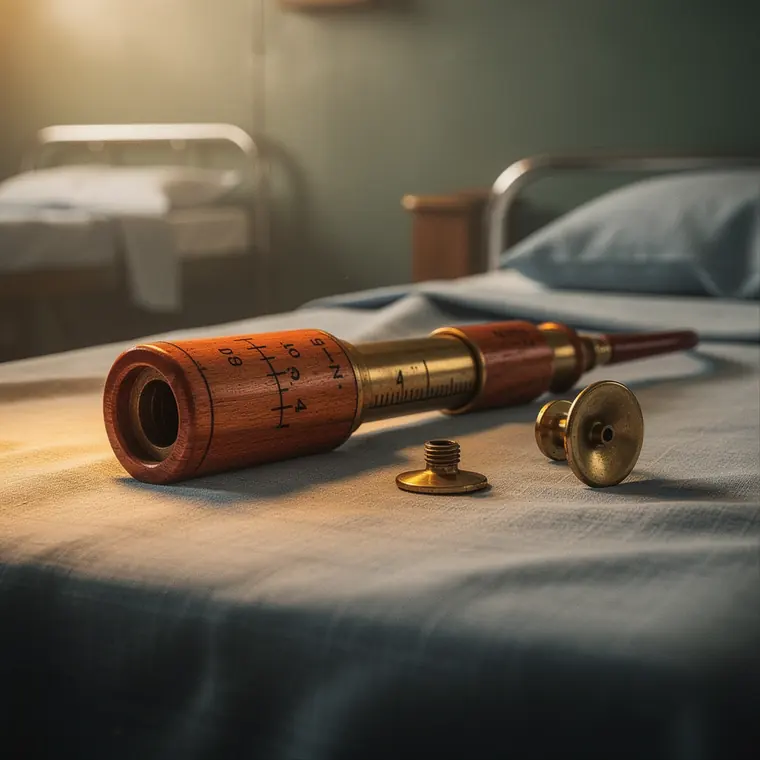
Laennec's turned wooden cylinder stethoscope pressed to a patient's chest on a ward of the Necker hospital in Paris, its detachable ear piece unscrewed on the bed.
- What it was used for
- René Laennec, physician at the Hôpital Necker in Paris from 1816, used the wooden cylinder to listen to his patients' hearts and lungs. He compared the sounds with autopsy findings and so classified diseases such as pneumonia, pleurisy and phthisis. According to the Science Museum, the trigger in 1816 was a young woman to whose chest he did not want to put his ear; he first used a rolled-up paper. The turned rod of cedar or walnut measured about 32.5 cm by 4 cm according to Laennec's book; a piece attributed to him in the Science Museum is 24.3 cm long. Buyers of the first edition could get the cylinder for 2 francs. Laennec died of tuberculosis in 1826.
- What was new
- Before, physicians put the ear directly on the chest. Laennec placed a cylinder in between and called the procedure mediate auscultation. What was new was less the tube than the method: linking sounds systematically to organ findings and naming them, such as râle or egophony. He presented the method to the Académie des sciences on 23 February 1818; the book "De l'auscultation médiate" appeared in 1819. The wooden rod itself did not last: doctors in France, Britain and America quickly built their own models, and in 1841 Barth and Roger wrote that the cylinder had been nearly abandoned. The two-eared stethoscope came only in 1852, from George Cammann.
Further reading
- Claude Renner: Évolution du stéthoscope de Laennec à Cammann, Histoire des sciences médicales XLIII (4), 2009, S. 407–416
- Science Museum Group Collection: Laennec's stethoscope (A106078)
- Bibliothèque de l'Académie nationale de médecine: Bicentenaire du stéthoscope de Laennec
- Roguin A.: Rene Théophile Hyacinthe Laënnec (1781–1826): The Man Behind the Stethoscope, Clinical Medicine & Research 4 (3), 2006, doi:10.3121/cmr.4.3.230 (Abstract via PubMed)
- Hektoen International: René Théophile Hyacinthe Laënnec and the stethoscope (2017)