Swan Neck Flasks
1861 · Swan Neck Flask · Work 212 of 1,871
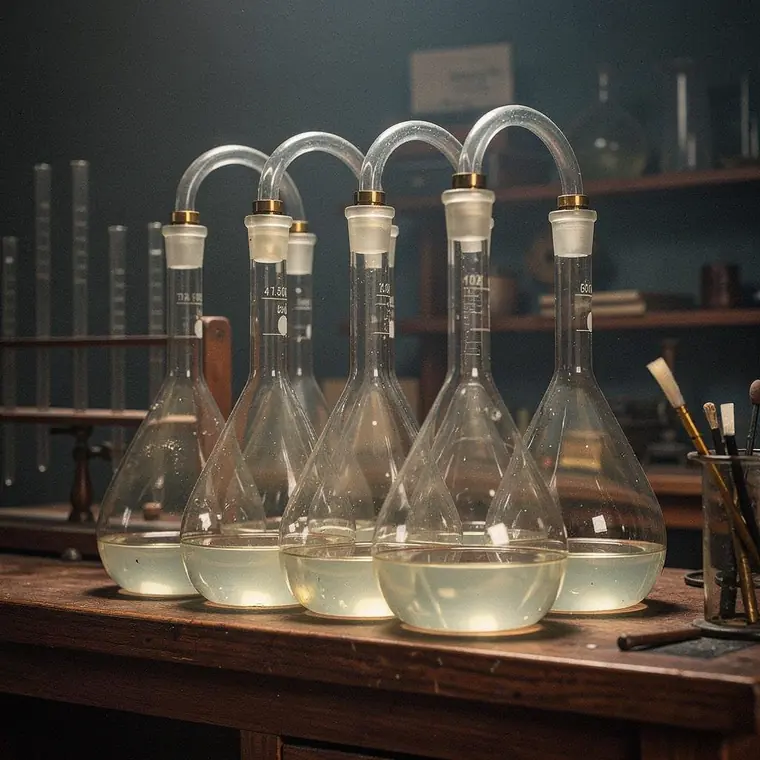
Pasteur's swan neck flasks on a shelf in the Ecole Normale laboratory in Paris, drawn glass tubes curving down and up, sterile broth standing untouched inside.
- What it was used for
- Louis Pasteur used the flasks in his laboratory at the École normale supérieure in Paris to show, against Félix Pouchet, that no life arises by itself in boiled nutrient liquids. He filled in a putrescible liquid, drew out the neck, bent it several times and boiled for two to three minutes. The neck stayed open, yet the liquid stayed unaltered: the dust carrying the germs was caught in the bend. When he broke off the neck, microorganisms appeared within one to two days. He described this on 19 May 1861 before the Société chimique de Paris; the full mémoire appeared in 1862. The Académie des sciences crowned the work with the Prix Alhumbert on 29 December 1862.
- What was new
- Earlier experiments had shut out the air or heated it first, as Theodor Schwann did in 1837; supporters of spontaneous generation such as Pouchet, who presented his first results in December 1858, could appeal to some unknown principle in the air. The swan neck let unheated air reach the liquid freely and held back only the dust. Whether the idea was Pasteur's is not clear: the Institut Pasteur writes that his teacher Antoine Jérôme Balard recommended the flask to him. In 1861 Pasteur himself did not claim that spontaneous generation never happens; such a negative could not be proven, he said. He also admitted he did not know why hay infusions prepared cold showed larger and more varied infusoria than boiled ones.
Further reading
- Louis Pasteur: Sur les corpuscules organisés qui existent dans l'atmosphère. Leçon professée à la Société chimique de Paris le 19 mai 1861 (Paris 1861; Digitalisat Wellcome Collection/Internet Archive b30478248), S. 9–10, 25–27
- Wellcome Collection: Pasteur, Mémoire sur les corpuscules organisés qui existent dans l'atmosphère (Paris 1862, 110 S.; Extrait des Annales de chimie et de physique, 3e série, t. LXIV)
- N. Joly: Examen critique du mémoire de M. Pasteur relatif aux générations spontanées, et couronné par l'Académie des sciences de Paris, dans sa séance du 29 décembre 1862 (Toulouse 1863), Gallica
- Institut Pasteur / Musée Pasteur: Ausstellung 1822–1895 (2022) – Balard, Ballon à col de cygne
- Institut Pasteur: Broschüre Musée Pasteur (Chronologie: 1862 Prix Alhumbert; Beschreibung des Schwanenhalskolbens)
- Institut Pasteur: Les travaux de Louis Pasteur de 1862 à 1877
- Les Amis de Pasteur: Les générations dites spontanées (Labor in den Dachräumen der ENS, 1858–1862)
- Encyclopedia.com (Science in Dispute): Historic Dispute – Are infusoria produced by spontaneous generation? (Pouchet 1858 vor der Académie des sciences; Hétérogénie 1859)