Koch Plate Cultures
1881 · Bacterial Culture · Work 213 of 1,871
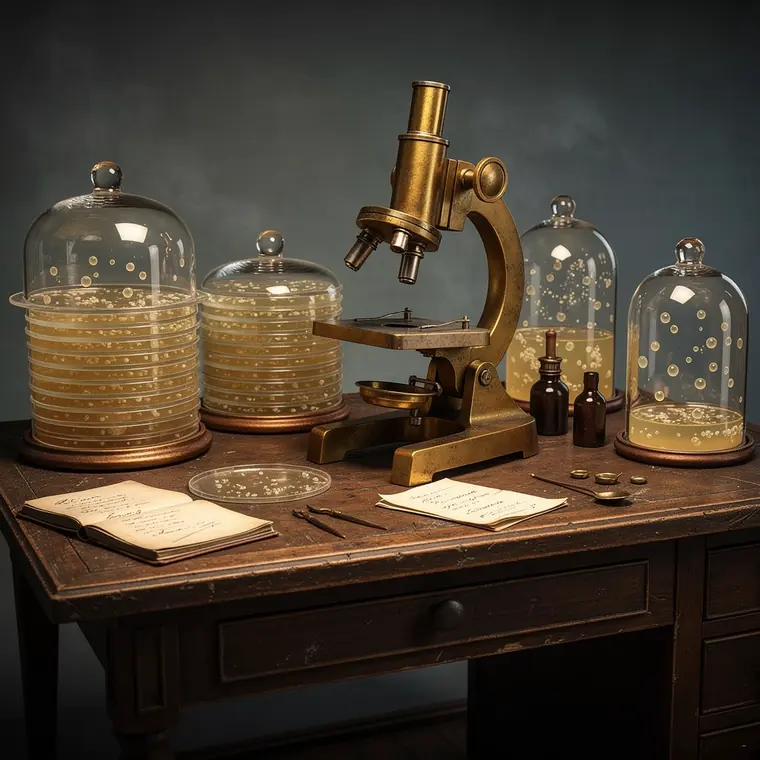
Robert Koch's flat glass plates of nutrient gelatine stacked under bell jars in his Berlin laboratory, colonies dotting the surfaces beside a microscope with a photographic attachment.
- What it was used for
- Robert Koch, at the Imperial Health Office in Berlin since 1880, described the method in 1881 in "Zur Untersuchung von pathogenen Organismen" (Mittheilungen aus dem Kaiserlichen Gesundheitsamte, vol. 1). Its purpose was pure culture: growing single bacterial species apart from all others, for the office's work on infectious disease and disinfection. Koch set nutrient broth with 2.5 to 3 percent gelatin and spread it about two millimetres thick on glass microscope slides, stacked under glass bells in moist chambers. With a flamed needle he could start twelve to fifteen separate cultures in one sitting. He used the same gelatin surfaces to test air and soil samples for germs.
- What was new
- Solid media as such were not new: around 1872 Joseph Schroeter had isolated pigmented bacterial colonies on potato slices, and Oskar Brefeld had grown fungi from single spores on gelatin. Koch himself started from the boiled potato. What was new was turning any proven nutrient broth into a firm, transparent gel: each germ grew in place into a separate colony that could be checked under the microscope, instead of mixing with all the others as in broth. But gelatin had a drawback: it turns liquid at the warmth many pathogens need, and some bacteria digest it. The replacement, agar, was suggested by Fanny Hesse (summer 1881 according to the Science History Institute, 1882 in the ASM timeline); she never published on it. The covered double dish was described by Julius Petri in 1887 under the title "Eine kleine Modification des Koch'schen Plattenverfahrens" - and it now bears his name.
Further reading
- Robert Koch: Zur Untersuchung von pathogenen Organismen (1881), in: Gesammelte Werke Bd. 1, S. 112–163 – Robert Koch-Institut, edoc
- Robert Koch-Institut: Robert Koch – Der Mitbegründer der Mikrobiologie
- Center for the History of Microbiology/ASM Archives (CHOMA): Significant Events 1861–1891
- Science History Institute: Fanny Angelina Hesse (Corrado Nai, 2025)
- Science History Institute: Julius Richard Petri (mit Nachweis Petri 1887, Centralblatt für Bakteriologie und Parasitenkunde 1: 279–280)
- Mattering Press, Boxes: 28 – Petri dish (zitiert Petri 1887, S. 279)
- Robert Koch: Zur Untersuchung von pathogenen Organismen (Sonderdruck 1881), Volltext-Digitalisat Wellcome Collection/Internet Archive (b21303095) – S. 26: 2½- bis 3procentige Gelatine, Tropfen etwa zwei Millimeter dick, zwölf bis fünfzehn Einzelculturen; Luft- und Bodenuntersuchung