Harrison H1
1735 · Sea Clock · Work 214 of 1,871
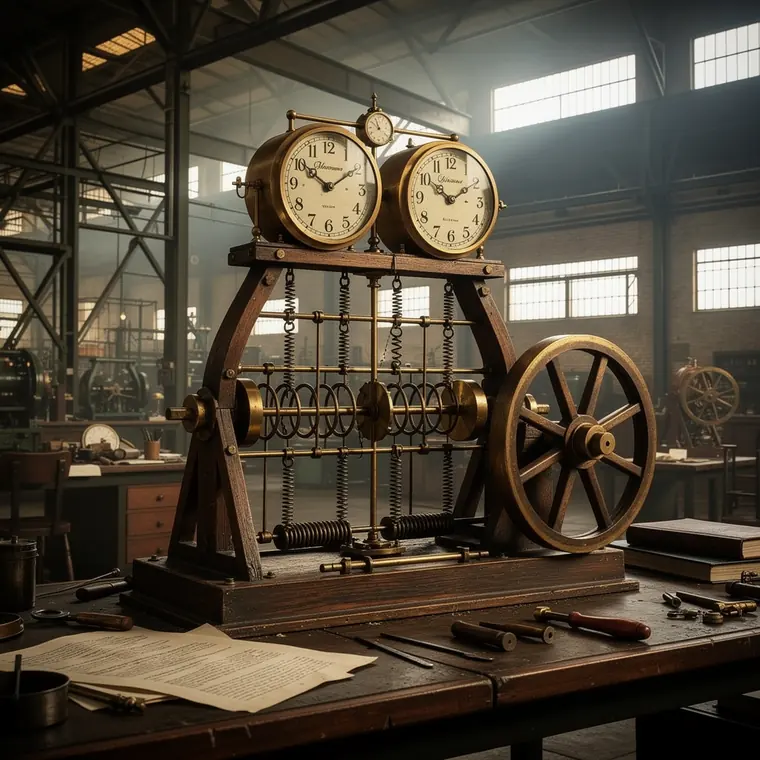
John Harrison's first sea clock on a gimballed stand, four brass dials above an open frame of dumbbell balances linked by helical springs, in a London workshop.
- What it was used for
- John Harrison built H1 between 1730 and 1735 at Barrow upon Humber to carry home-port time to sea; the difference from local time gives the longitude. After tests on the Humber he brought it to London in 1735. In May 1736 it sailed with him on HMS Centurion to Lisbon, returning on the Orford. Off the English coast Harrison used it to show that a headland the officers took for the Start was the Lizard - by the account of Royal Museums Greenwich the ship was some 60 miles off course. On 30 June 1737 the Commissioners of Longitude granted £500, £250 of it paid at once for an improved clock.
- What was new
- Pendulum clocks failed on a rolling ship. H1 replaced the pendulum with two interconnected swinging balances, which the ship's motion did not disturb; it compensated for temperature and, thanks to anti-friction devices, ran with no oil at all. Royal Museums Greenwich call it the first relatively successful marine timekeeper - not the first one ever. Yet after Lisbon Harrison did not ask for the West Indies trial the 1714 Act called for, but for money to build a better clock; the answer came only in 1759 with H4, a completely different design. Rupert Gould found H1 neglected in the Royal Observatory's stores in 1920 and rebuilt it in 1932-33. According to Royal Museums Greenwich, a replica is currently on show there while the original is under conservation.
Further reading
- Royal Museums Greenwich: Longitude found – the story of Harrison's timekeepers
- Royal Museums Greenwich, Collections: H1 (ZAA0034)
- Royal Museums Greenwich, Archiv: Gould, Rupert Thomas (GOU) – u. a. GOU/4 Notizbuch zur Rekonstruktion von Harrisons No. 1, 1932–33
- National Maritime Museum (J. O'Donnell/ROG, 2002): John Harrison and the Longitude problem – archivierte Kopie