Harrison H4
1761 · Marine Chronometer · Work 215 of 1,871
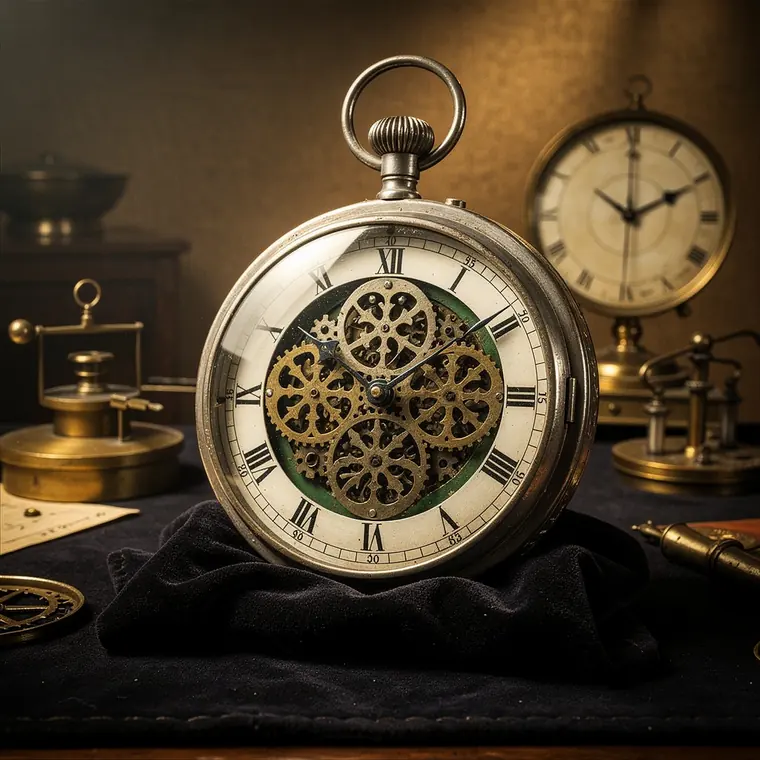
Harrison's fourth timekeeper, a large silver pair cased watch with an enamel dial and pierced foliate balance cock, resting on velvet in the Board of Longitude trial room.
- What it was used for
- H4, completed in 1759 and weighing 1.45 kg, was Harrison's test piece for the longitude reward. His son William took it to Jamaica on the Deptford, sailing on 18 November 1761 and arriving on 19 January 1762; on the way he used it to predict Madeira earlier than the crew expected. A second trial followed on the Tartar to Barbados, sailing on 28 March 1764. From May 1766 Astronomer Royal Nevil Maskelyne tested it for ten months at Greenwich, with poor results. Cook's second and third voyages carried not H4 but Larcum Kendall's copy K1 of 1769 - a copy the Board refused to count as one of Harrison's own.
- What was new
- In the 1750s a pocket watch was not considered a precision instrument. H4 looked like a large pocket watch, but its big, fast balance ticked five times a second. On arrival in Jamaica it was 5.1 seconds slow, according to the National Maritime Museum; on the Barbados trial its error was computed at 39.2 seconds over 47 days. Lunar distances and Jupiter's moons matured in parallel as rival methods; historian Rebekah Higgitt argues the timekeeper could only take hold working in tandem with the lunar-distance method. In 1765 the Board granted half and demanded copies; it never awarded the full reward. In 1773 Parliament voted Harrison £8,750 by a separate Act.
Further reading
- Royal Museums Greenwich, Collections: H4 (ZAA0037)
- Royal Museums Greenwich: Longitude found – the story of Harrison's timekeepers
- Royal Museums Greenwich, Collections: K1 (Larcum Kendall, 1769)
- National Maritime Museum (J. O'Donnell/ROG, 2002): John Harrison and the Longitude problem – archivierte Kopie
- Rebekah Higgitt: There was no such thing as the Longitude Prize #2 (teleskopos, 2014; nach Derek Howse)
- Office for National Statistics blog: Valuing John Harrison's work (2020)