Graham Mercury Regulator
1726 · Precision Pendulum Clock · Work 216 of 1,871
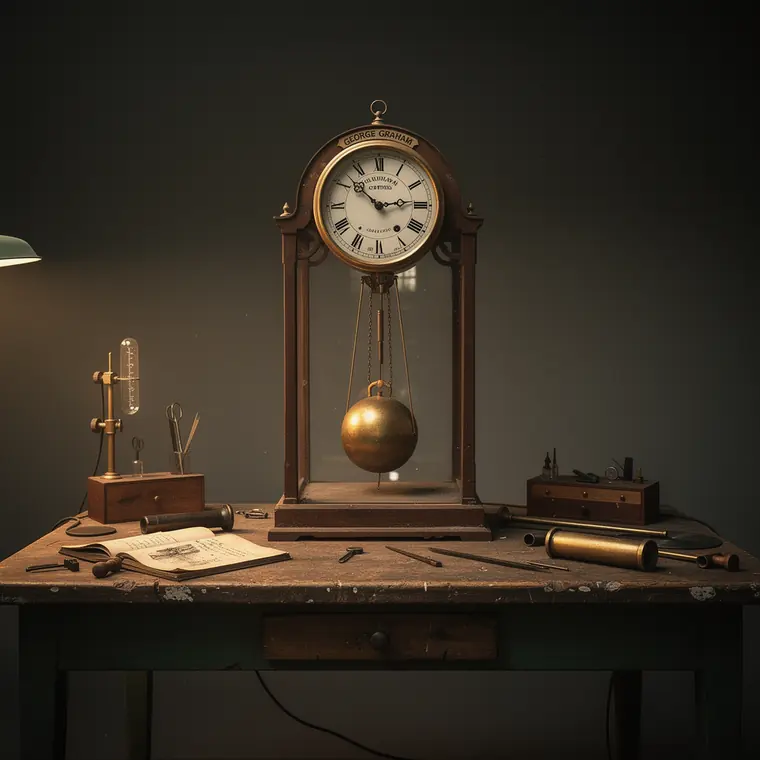
George Graham's regulator clock standing open in his Fleet Street workshop, a jar of mercury forming the pendulum bob, deadbeat escapement above the seconds dial.
- What it was used for
- The London clockmaker George Graham built precision pendulum clocks that astronomers used to time star transits across the meridian. He tested his mercury-pendulum clock himself: it ran from June 1722 to October 1725, three years and four months, without its hands or pendulum being altered. In the same unheated room, a comparison clock with an ordinary pendulum varied by up to 30 seconds a day between the hottest and coldest weather of 1722. In 1750 the Royal Observatory Greenwich under James Bradley bought the clock Graham 3, signed by Graham but made by his assistant John Shelton, for £39 – delivered with a gridiron pendulum, the two-metal principle Graham himself had abandoned. The mercury pendulum it carries today was fitted later, about 1824 according to a later note by the Greenwich astronomer Airy.
- What was new
- Graham used the large thermal expansion of mercury. A vessel of mercury forms the pendulum bob. When heat lengthens the rod, the mercury column rises, its centre of gravity moves up, and the effective pendulum length stays almost the same. By Graham's own account, his clock's error was at most one sixth, and usually one eighth to one ninth, of the comparison clock's. Around 1715 he had given up on compensating with two metals because the differences seemed too small; John Harrison later took exactly that route. He hit on mercury by chance in December 1721, while making a level. The paper is dated 18 April 1726 and was read to the Royal Society on 28 April 1726.