Riefler Vacuum Clock
1889 · Precision Pendulum Clock · Work 217 of 1,871
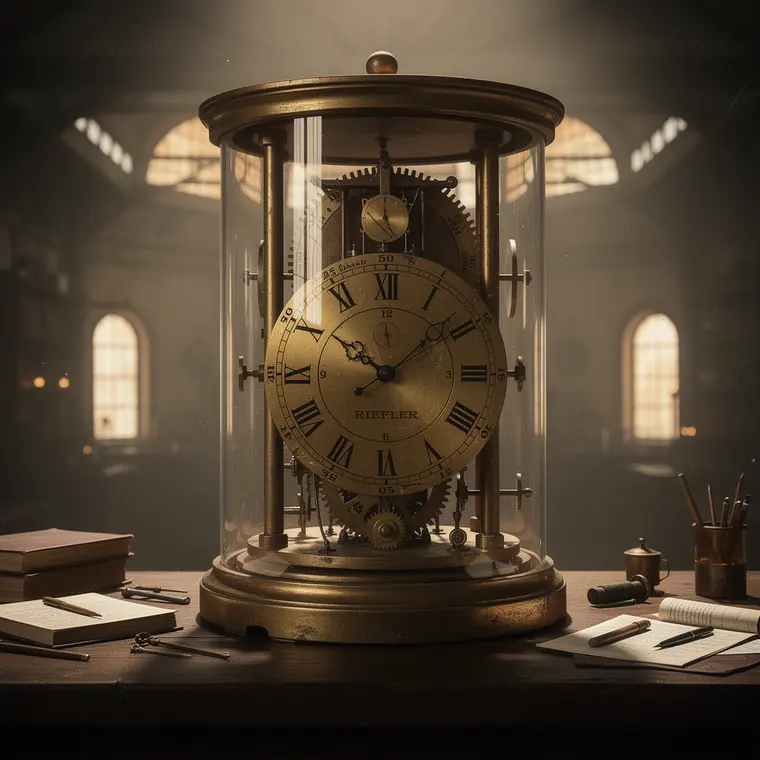
A Riefler precision pendulum clock sealed inside its cylindrical glass vacuum tank in a Munich observatory cellar, steel pendulum rod hanging from the flexing suspension spring.
- What it was used for
- Riefler clocks served as master clocks in observatories and time services; according to the Deutsches Museum they also gave time signals for shipping and radio. The Munich firm Clemens Riefler sold 635 precision pendulum clocks between 1890 and 1965. The US National Bureau of Standards (now NIST) bought one in 1904 as its first own time standard. NIST says it routinely held an uncertainty of about 10 milliseconds a day; it was calibrated against time signals from the U.S. Naval Observatory. In 1929 a Shortt clock with about 1 ms a day replaced it. For Greenwich the sources disagree: Royal Museums Greenwich says no Riefler was ever used there, perhaps for patriotic reasons; royalobservatorygreenwich.org records the purchase of the second-hand No. 50 in 1920.
- What was new
- Riefler's escapement was patented in 1889 (German patent no. 50739). The drive does not go through a crutch: the pendulum is impulsed through its suspension block and otherwise swings almost undisturbed. He added his own pendulums, a mercury compensation pendulum in 1891 and a nickel-steel rod in 1897. In the most accurate types the pendulum swung inside a partly evacuated copper cylinder, so changes in air pressure no longer altered the rate; when these cylinders were introduced could not be established. According to Royal Museums Greenwich, Riefler regulators were the best timekeepers available until Shortt's free-pendulum clock. The year 1889 belongs to the escapement, not to the vacuum.