Musschenbroek Jar
1746 · Leyden Jar · Work 220 of 1,871
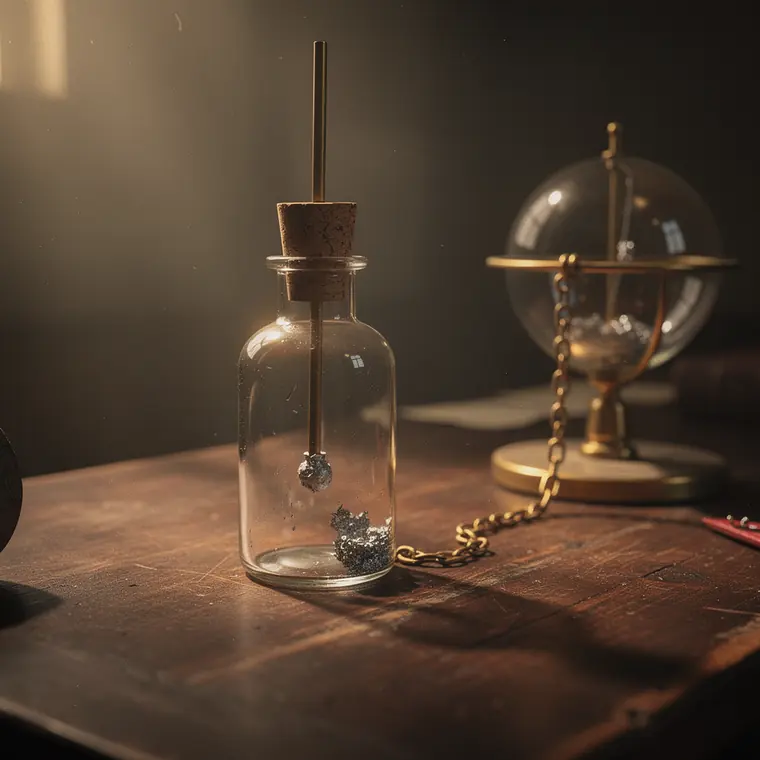
A Leyden jar on the demonstration table of a Dutch university cabinet, glass jar lined with foil and a brass rod through the cork, chain trailing to a globe machine.
- What it was used for
- The jar stored the charge of a friction machine, which otherwise leaked away quickly into the air, especially in damp weather. Pieter van Musschenbroek worked with it at Leiden University, together with Andreas Cunaeus. The jar soon became standard equipment for experiments and demonstrations. In April 1746 Abbé Nollet sent a discharge through a chain of 180 Royal Guards in front of Louis XV. Benjamin Franklin used it to study the electricity of lightning.
- What was new
- According to Britannica, the jar made it possible for the first time to store large amounts of charge and to give sparks and shocks conveniently; before, a friction machine delivered only what it was producing at that moment. At least two people reached it independently: Ewald Georg von Kleist in Pomerania charged a similar bottle on 15 October 1745, and in Leiden it happened in late 1745 or early 1746. Musschenbroek reported it to Réaumur in a letter of 20 January 1746. He had set out to hold electricity in water – but the charge is stored between an inner and an outer conductor, separated by the glass. The jar is named after Leiden, although Kleist's experiment is older.
Further reading
- Rijksmuseum Boerhaave, Drie laagjes die de wereld veranderden
- Britannica, Electromagnetism: Invention of the Leyden jar
- Linda Hall Library, Scientist of the Day: Pieter van Musschenbroek
- Lorentz Institute, Leiden University, The Leiden jar
- Chemistry World, Von Kleist's jar
- ETHW, Nollet Electrifies Royal Guard