Volta Pile
1800 · Voltaic Pile · Work 222 of 1,871
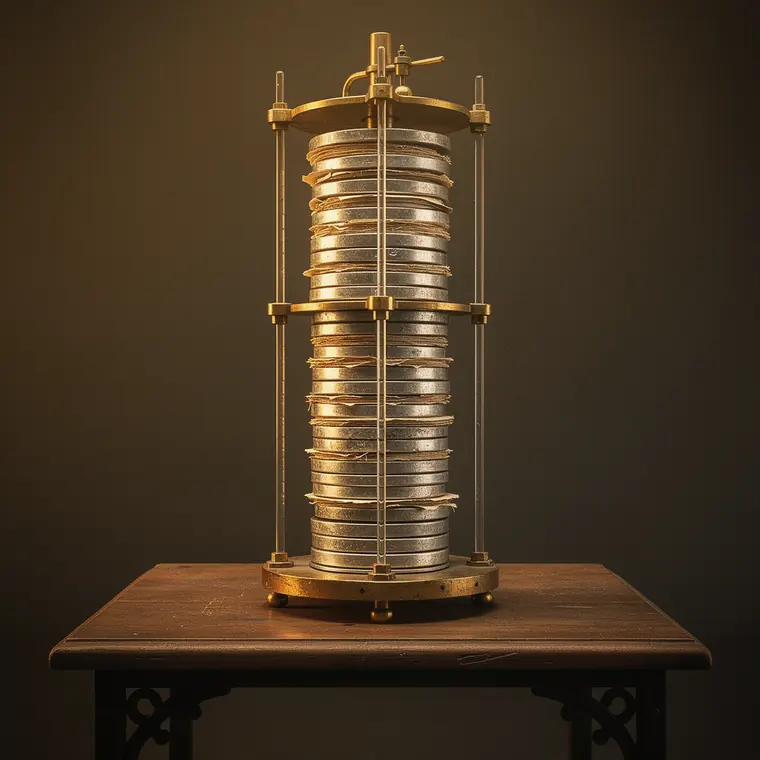
Volta's pile standing on a Pavia lecture bench, a column of alternating zinc and silver discs separated by brine soaked card, glass rods holding the stack upright.
- What it was used for
- Alessandro Volta, professor of physics at Pavia, built the pile to settle a dispute: electricity arises from the mere contact of different metals, not, as Luigi Galvani held, in animal tissue. He described it in a letter in French to Joseph Banks, President of the Royal Society, dated Como, 20 March 1800, read on 26 June 1800 and printed in Philosophical Transactions vol. 90. Volta wrote that it used 30, 40, 60 or more pairs of copper or silver with zinc, separated by salt water or soaked card. Banks showed the first part of the letter to Anthony Carlisle, who rebuilt the pile with William Nicholson and used it to decompose water. In 1807 Humphry Davy used such batteries to isolate potassium and sodium.
- What was new
- A Leyden jar gave a single discharge and then had to be recharged from outside. Volta's pile rebuilt its charge by itself after each discharge and so delivered a steady current instead of a single shock. Volta called it an artificial electric organ and compared it with the torpedo fish – a device against animal electricity, modelled on an animal. His contact explanation did not hold up either. According to the chemist Luigi Fabbrizzi (2019), the correct chemical explanation of the pile and of electrolysis took nearly a century to arrive, and Nicholson's report on splitting water appeared months before Volta's own letter.
Further reading
- Volta, On the Electricity excited by the mere Contact of conducting Substances, Phil. Trans. 90 (1800), Scan
- Fabbrizzi, Strange Case of Signor Volta and Mister Nicholson, Angew. Chem. 2019 (Abstract, Europe PMC)
- Chemistry World, Enterprise and electrolysis
- Science History Institute, Science and Celebrity: Humphry Davy's Rising Star