Faraday Induction Ring
1831 · Induction Ring · Work 223 of 1,871
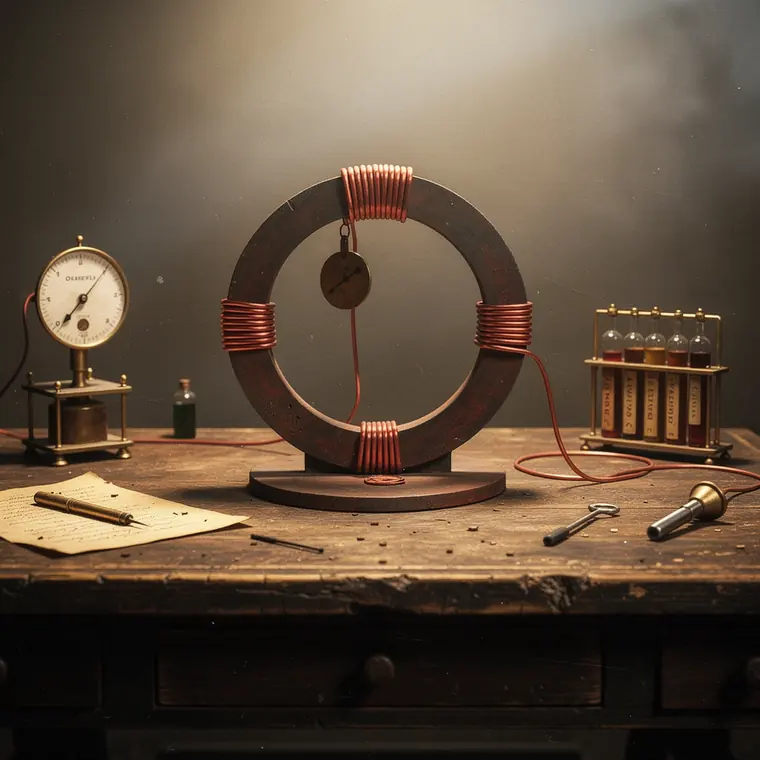
Faraday's six inch iron ring wound with two separate coils of insulated copper wire on a bench in the Royal Institution basement, a galvanometer and a battery of cells alongside.
- What it was used for
- The ring was an experimental set-up, not a tool for others. Michael Faraday used it on 29 August 1831 in the basement laboratory of the Royal Institution in London. By his own account it was a welded ring of soft round iron, 7/8 inch thick and 6 inches in external diameter. One side carried three coils of about 24 feet of copper wire each, the other about 60 feet. One side was connected to a battery of ten pairs of plates, the other to a galvanometer. The Royal Institution estimates that winding the coils and insulating them with cotton took about ten working days. Faraday reported the results to the Royal Society on 24 November 1831.
- What was new
- The ring showed that a current in one coil produces, through the iron core, a current in a second, unconnected coil. According to the Royal Institution, Faraday had been looking for a current from magnetism since the 1820s – and got only a brief deflection when the circuit closed and an opposite one when it opened. With a steady current the needle returned to rest. This short-lived effect is exactly the principle on which the Royal Institution calls the ring the first transformer. Joseph Henry was working on the same problem in Albany at the same time; the Smithsonian Institution Archives credit Faraday because he reported first. Henry discovered self-induction, which he announced in July 1832.