Crookes Maltese Cross
1879 · Cathode Ray Tube · Work 225 of 1,871
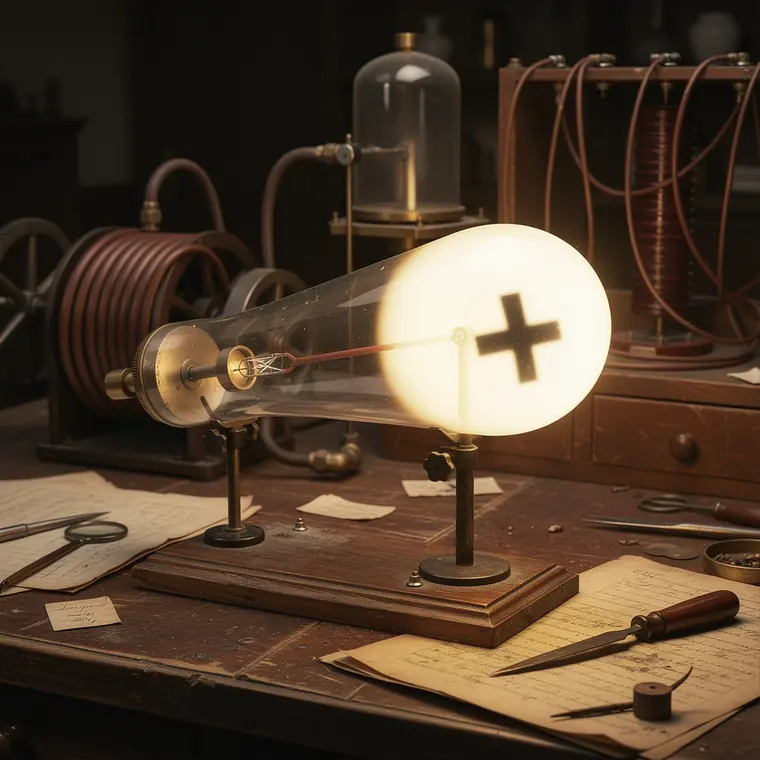
A Crookes tube clamped on a stand in a London laboratory: a sealed elongated glass tube of pear shape, a disc cathode sealed into the narrow end with a wire lead, a flat metal Maltese cross electrode standing upright inside the tube in the path of the rays, the wide end of the glass glowing with fluorescence and carrying the sharp dark shadow of the cross, mercury vacuum pump and induction coil connected behind by wires.
- What it was used for
- William Crookes demonstrated the tube in Sheffield on 22 August 1879, in his lecture "On Radiant Matter" to the British Association for the Advancement of Science. An aluminium cross stood inside the tube. Rays from the negative electrode were partly blocked by it, and its outline appeared as a shadow on the glowing glass. This showed that cathode rays travel in straight lines and are stopped by thin metal. Crookes put the vacuum at about a millionth of an atmosphere. Such tubes were later made in series as teaching devices, for example by the firm Otto Pressler.
- What was new
- The shadow itself was not new: Johann Wilhelm Hittorf had shown in 1869 that an object in a discharge tube casts a shadow. Crookes added a second observation. After long running the glass glowed less brightly; he called it tired. When the cross was folded down, a bright cross appeared in the same place, because the glass that had been in shadow was still fresh. Crookes read the rays as matter in a fourth state. According to the Röntgen biographer Otto Glasser (1953), Crookes found fogged photographic plates in unopened boxes and complained to the manufacturer several times. He did not recognise the radiation from his own tubes that was the likely cause.
Further reading
- Crookes, On Radiant Matter, Popular Science Monthly 16 (Nov. 1879), Wikisource
- Crookes, On radiant matter (1879), Internet Archive
- ORAU Museum of Radiation and Radioactivity, Maltese Cross Crookes Tube
- Purdue University, Johannes Hittorf
- Otto Glasser, The Human Side of Science, Cleveland Clinic Quarterly 20 (1953)