Wurzburg Discharge Tube
1895 · X-Ray Apparatus · Work 226 of 1,871
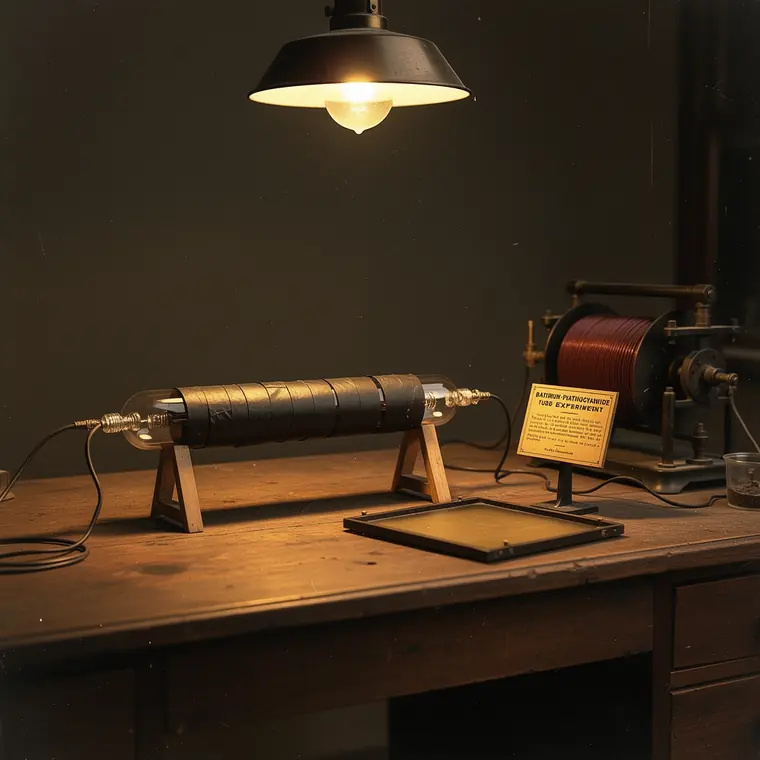
Roentgen's discharge tube on a bench at the Wurzburg physical institute: an elongated glass vacuum tube with wire electrodes sealed through the glass, wires from the electrodes running to a large induction coil standing on the same bench, the whole glass tube wrapped closely in a sleeve of black cardboard that follows its shape, a small cardboard screen painted with barium platinocyanide on a stand and a photographic plate holder nearby, the room darkened.
- What it was used for
- With this tube Wilhelm Conrad Röntgen found an unknown radiation at the Physical Institute of the University of Würzburg; he first observed it on 8 November 1895. According to the Deutsches Röntgen-Museum, the set-up was a Hittorf tube in a wooden frame, a mercury vacuum pump and a large Ruhmkorff induction coil. A screen coated with barium platinocyanide lit up in the dark room at every discharge, even 2 metres away. On 22 December 1895 he took a radiograph of the left hand of his wife Anna Bertha, showing bones and wedding ring. On 28 December 1895 he submitted "Ueber eine neue Art von Strahlen" to the Physical-Medical Society of Würzburg.
- What was new
- The tube itself was not new. Discharge tubes like it stood in many laboratories, and others had already fogged photographic plates with them without recognising the cause. According to Otto Glasser, Arthur W. Goodspeed in Philadelphia made an accidental X-ray photograph on 22 February 1890, recognised as such only in 1896. What was new was that Röntgen recognised a distinct radiation from the tube that passed through cardboard and showed the bones of a living hand. According to the University of Münster, Röntgen took out no patent, and the method therefore spread quickly.
Further reading
- R. F. Dondelinger, The idea of tomography was published together with the news of the discovery of Röntgen rays – a historical note, European Radiology 30 (2020) 4141–4142
- Deutsches Röntgen-Museum (museum-digital), Versuchsaufbau im Physikalischen Institut 1895
- Universität Münster, medicampus, Röntgen-Info
- Otto Glasser, The Human Side of Science, Cleveland Clinic Quarterly 20 (1953)