Liebig Kaliapparat
1831 · Combustion Analysis · Work 230 of 1,871
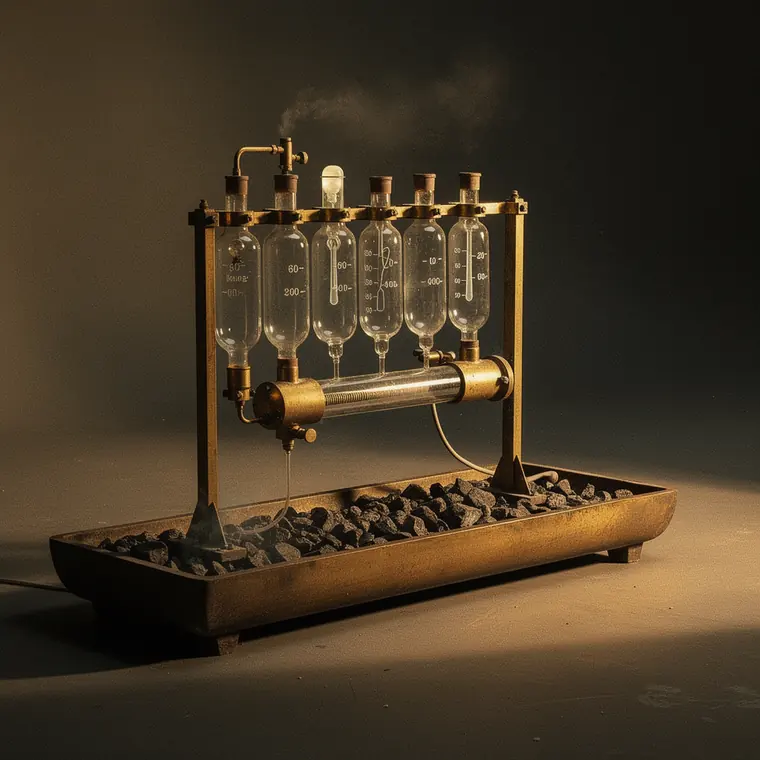
Liebig's five bulb potash apparatus mounted on a stand in a Giessen analysis room, a combustion tube in its charcoal trough running toward the row of glass bulbs.
- What it was used for
- With the Kaliapparat Justus Liebig measured the carbon content of organic substances. The sample was burned with copper oxide in a glass tube, the water taken up by calcium chloride and the carbon dioxide by potash solution in the apparatus's five glass bulbs. The gain in weight gave the carbon. According to Drier and Jackson, the apparatus was made in autumn 1830; Liebig published it in 1831 in the Annalen der Physik. At Giessen large numbers of students worked with it, and according to C&EN this let Liebig produce results faster than rivals in France and England.
- What was new
- Combustion analysis existed before, for example with Berzelius. According to the chemist Andrea Sella, however, it was slow and unreliable and needed a lot of material. With the Kaliapparat less than a gram was enough, and carbon and hydrogen could be determined precisely in about an hour. A task for specialists became a routine procedure. Yet according to the historian Catherine Jackson, Liebig still failed with it on difficult alkaloids such as morphine and quinine. The American Chemical Society put the apparatus into its emblem in 1908 or 1909; sources give both years.
Further reading
- Andrea Sella, Liebig's Kaliapparat, Chemistry World
- C&EN, A Most Important Artifact
- Drier & Jackson, Liebig's Kaliapparat and the Origins of Scientific Glassblowing (ORA Oxford)
- Merck KGaA, Corporate & Family Heritage, Objects: The Five-Bulb apparatus
- Midland ACS Centennial, ACS Logo History
- UW–Madison History, What's in a logo? A Kaliapparat