Benediktbeuern Spectrometer
1814 · Spectrometer · Work 233 of 1,871
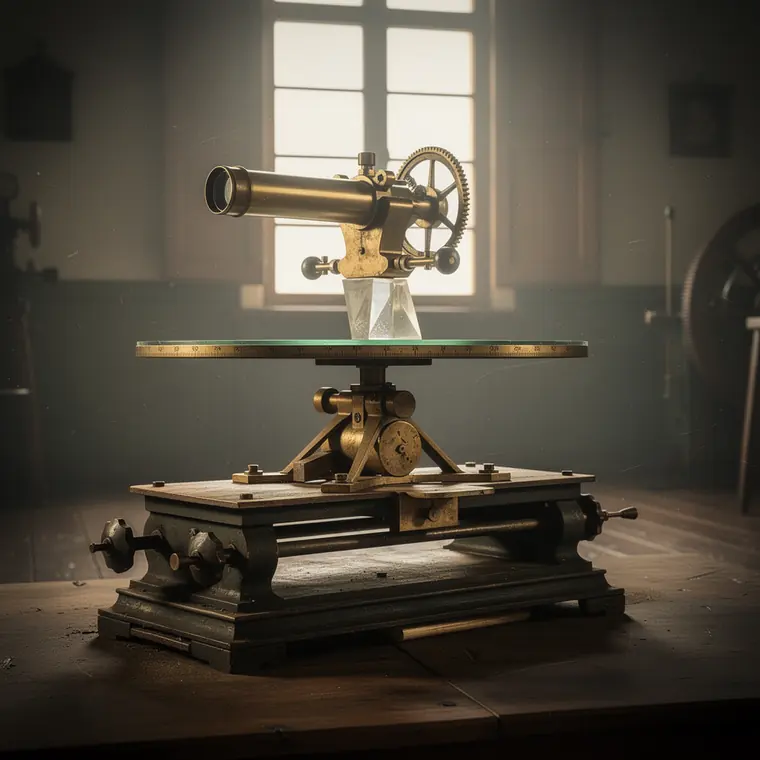
Fraunhofer's prism spectrometer at Benediktbeuern, a flint glass prism on a divided circle with a small theodolite telescope aimed at a narrow slit in the shuttered window.
- What it was used for
- At the optical glassworks Joseph von Utzschneider set up from 1805 in Benediktbeuern Abbey, Joseph Fraunhofer tested glass for achromatic telescope objectives. For this he first experimented with glass prisms. The dark lines of the solar spectrum served as fixed markers to determine each glass's refractive and dispersive indices precisely. He counted 574 lines of various thicknesses and drew them. The observations date from 1814; he submitted the paper to the Bavarian Academy in April 1817, printed in its Denkschriften for 1814 and 1815.
- What was new
- William Hyde Wollaston had seen dark lines as early as 1802; Fraunhofer rediscovered them independently. What he could do that Wollaston had not: he counted and drew hundreds of lines, used them as fixed reference points and so made the refraction of glass precisely measurable rather than estimated. The twist: a quality-control tool for a glassworks became the basis of spectral analysis. In 1859 Kirchhoff and Bunsen showed that the dark lines coincide with the bright lines of heated gases, which made the chemical make-up of the Sun readable.