Pantheon Pendulum
1851 · Pendulum Experiment · Work 234 of 1,871
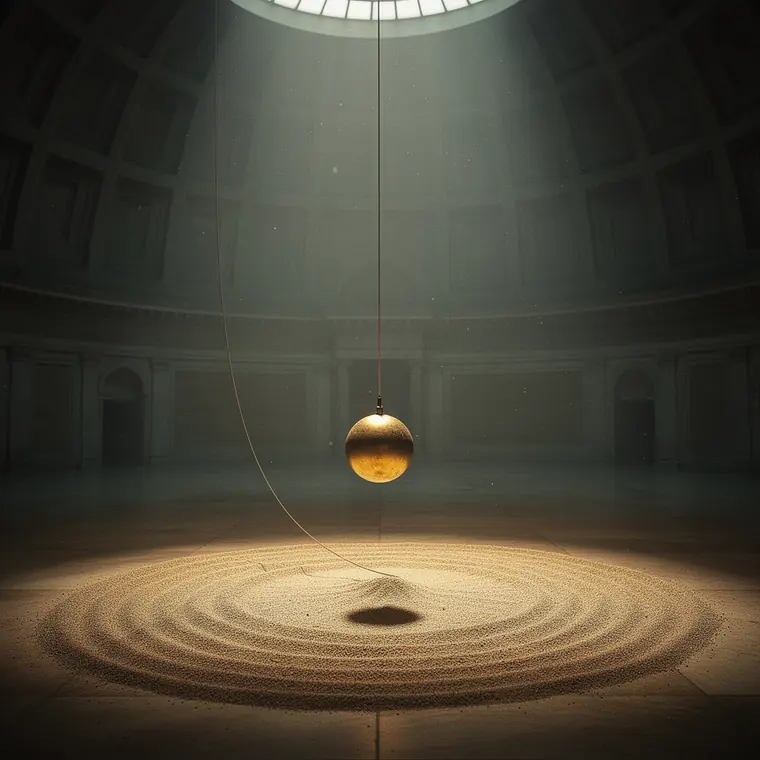
Foucault's pendulum swinging in the Pantheon in Paris, a brass bob on a long wire from the dome, its pointer scoring a ring of sand spread on the floor.
- What it was used for
- Léon Foucault used the pendulum to show the Earth's rotation, which until then could only be inferred from the motion of the stars. He first tried it in early 1851 in his cellar with a 2 m wire and a 5 kg bob, then in the meridian hall of the Paris Observatory with 11 m; on 3 February 1851 the work was communicated to the Académie des sciences. From March 1851, at the request of Louis-Napoléon Bonaparte, a 28 kg brass-and-lead bob hung in the Panthéon on a 67 m steel wire, built by the instrument maker Gustave Froment. A stylus traced lines in sand; according to the Musée des Arts et Métiers the plane of swing turned by about one degree every five minutes. The coup d'état of December 1851 ended the demonstrations.
- What was new
- The pendulum showed the Earth's rotation inside a building, without looking at the sky. Earlier falling-body experiments, in which a dropped object should drift eastward, had all failed according to the Musée des Arts et Métiers. In Paris the plane does not turn a full circle in 24 hours but only about 271 degrees a day, because the effect grows with the sine of the latitude; Foucault stated this law in his 1851 note. The twist: the museum itself says nobody doubted that the Earth turned, so the proof confirmed what everyone already believed. And in April 2010 the cable of an original bob at the Musée des Arts et Métiers snapped; the 28 kg sphere hit the marble floor and, according to curator Thierry Lalande, was irreparably dented.
Further reading
- Musée des arts et métiers, Les Carnets: Le pendule de Foucault (PDF)
- Musée des Arts et Métiers: Sphère du pendule de Léon Foucault
- Panthéon (Centre des monuments nationaux): Foucault's pendulum
- Foucault, Démonstration physique du mouvement de rotation de la Terre au moyen du pendule, Comptes rendus 32 (1851), S. 135–138 (Wikisource)
- Nature blogs (G. Brumfiel, 13.5.2010): Whoops! Foucault's pendulum comes crashing down