Michelson Morley Interferometer
1887 · Interferometer · Work 235 of 1,871
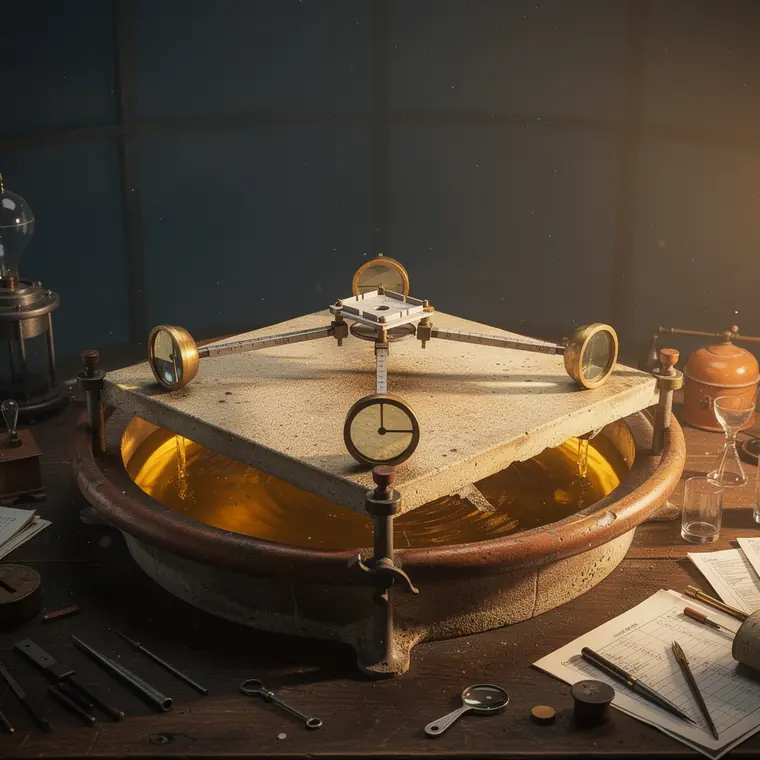
The Michelson and Morley interferometer in a Cleveland basement, a square sandstone slab floating in an annular mercury trough carrying mirrors at its corners and a central beam splitter.
- What it was used for
- Albert A. Michelson (Case School of Applied Science) and Edward W. Morley (Western Reserve University) built it to measure the Earth's motion through the assumed luminiferous ether. It stood in the basement of Adelbert Dormitory in Cleveland; observations ran between April and July 1887. The optics sat on a stone about 1.5 m square and 0.3 m thick, floating on a wooden ring in mercury so it could be turned slowly. The results appeared in the American Journal of Science, vol. 34, no. 203 (1887), pp. 333–345. The data series printed there come from only four days, 8, 9, 11 and 12 July 1887: noon readings on 8, 9 and 11 July, evening readings on 8, 9 and 12 July.
- What was new
- Michelson had tried the arrangement at Potsdam in 1880/81, but vibrations interfered, and according to the 1887 paper the effect may have been too small to detect. What was new in 1887 was the combination: the floating stone damped vibrations, and repeated reflection lengthened the light path to about 11 m, roughly ten times as much. By their own calculation the authors expected a shift of 0.4 fringe; the observed shift was certainly less than a twentieth of that, probably less than a fortieth. The twist: the repetitions at three-month intervals announced in the paper were never fully carried out. Michelson's 1907 Nobel Prize honoured his optical precision instruments and metrological investigations, not this experiment by name.
Further reading
- Michelson & Morley, On the Relative Motion of the Earth and the Luminiferous Ether, American Journal of Science 34 (203), 1887, S. 333–345 (Volltext auf Wikisource)
- Encyclopedia of Cleveland History (Case Western Reserve University): Michelson-Morley Experiment
- NobelPrize.org: The Nobel Prize in Physics 1907
- College of William & Mary, Physics 201 reading: The Michelson-Morley Experiment(s)